

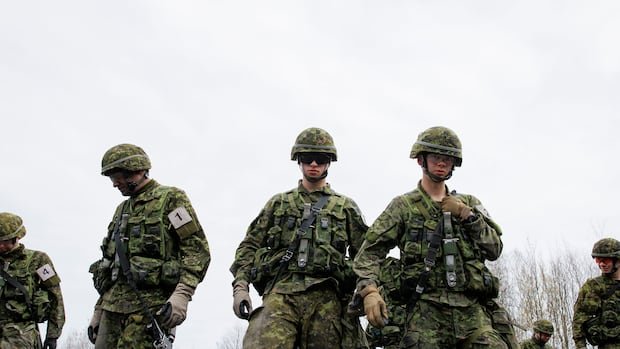

A leaked report circulating in Canada’s defense community reveals that an increased number of military recruits are failing basic training following changes aimed at boosting enrollment. According to the 15-page internal evaluation report dated January 27, the success rate dropped to 77% in 2025, down from 85% the previous year.
Last Thursday, defense officials confirmed the authenticity of the report authored by Lt.-Col. Marc Kieley, commandant of the Canadian Forces Leadership and Recruit School (CFLRS) in Saint-Jean-sur-Richelieu, Quebec. Despite achieving the highest recruitment levels in three decades and a modest growth in the Armed Forces’ overall size, the report highlighted concerns.
While the military surpassed its recruitment target, mainly due to the enrollment of 1,400 permanent residents, Kieley’s report pointed out issues such as an increase in mental health conditions, notably anxiety, among new recruits. The report indicated a rise in the proportion of candidates requiring multiple attempts to graduate from basic training, reaching 14.89%, significantly higher than the 8.44% rate in 2024.
In recent years, the federal government has eased policies related to pre-existing medical conditions and discontinued aptitude tests to enhance military recruitment. Additionally, the Defense Department expanded eligibility to include more foreign nationals and newly arrived Canadian permanent residents.
Kieley emphasized that the current basic training model assumes that around 85% of candidates can be effectively trained with the majority passing on their first attempt. The increase in failure rates has caused “significant friction” within the training school, which delivers basic military qualification courses and officer training.
The report also highlighted concerns regarding the rising number of applicants with mental health issues, with 92 recruit candidates requiring assistance from external healthcare facilities on multiple occasions. Kieley recommended closer monitoring of candidates with pre-existing medical conditions during recruitment.
Furthermore, changes allowing for the enrollment of permanent residents led to a higher presence of newly arrived immigrants in training units. Some units, comprising candidates with minimal Canadian residency, experienced culture shock and higher failure rates, with one French-speaking unit graduating only 48% of its class.
Permanent residents were described as a challenging demographic to train, with instances of alleged racism and internal conflicts within certain units. In officer training, permanent residents struggled with adapting to Canadian military culture, particularly in their interactions with female peers.
The report underscores the importance of addressing mental health concerns and cultural integration issues to ensure the effectiveness of military training programs.