

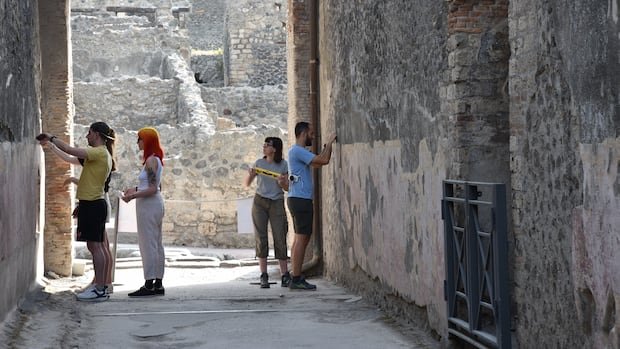

In ancient Pompeii, long before the term “street art” existed, residents were already creating graffiti on city walls, including jokes, insults, declarations of love, and suggestive drawings. Recently, an international research team utilized advanced digital imaging to uncover 79 previously unseen inscriptions in a narrow corridor connecting two theaters.
Under the project named “Corridor Whispers,” led by experts from Sorbonne University and Université du Québec à Montréal, researchers rediscovered these hidden graffiti. The initiative began when an archaeologist studying Pompeii’s theaters noticed the abundance of graffiti and collaborated with a Roman history professor intrigued by their resemblance to working-class lodging inscriptions.
Through extensive fieldwork in 2022 and 2025, the team reexamined around 300 wall inscriptions, unveiling the new discoveries, including a partially preserved love message dedicated to someone named Erato. Erato, associated with love poetry in Greco-Roman mythology, symbolized “beloved” in ancient Rome and was a common name for freed individuals or slaves.
The graffiti not only showcased intimate expressions but also depicted scenes of gladiator battles, animal drawings, ships, and symbolic phallic representations prevalent in Roman culture. Additionally, the graffiti provided insights into societal classes and gender dynamics, highlighting the presence of ordinary individuals in the ancient city.
The research team’s innovative use of Reflectance Transformation Imaging (RTI) technology allowed them to decipher the faint inscriptions on the corridor walls previously overlooked as random scratches. This technique illuminated the hidden details, offering a clear view of the historical marks left by various Pompeii residents, from spectators to soldiers.
While artificial intelligence was not utilized in this analysis, the potential for AI to enhance the understanding of Pompeii’s graffiti remains a topic of interest for scholars. The team plans to launch a digital platform in June, combining photogrammetry and high-resolution RTI data, allowing the public to virtually explore the ancient corridor and unravel its 2,000-year-old stories.