

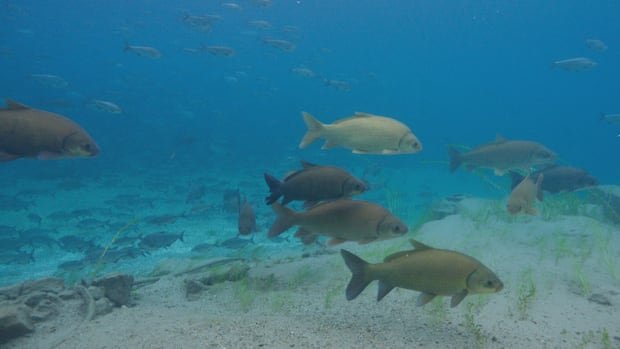

In Lake Huron, stunning underwater visuals have unveiled a rich marine ecosystem that a documentary team named “fish city” and highlighted for Earth Day. However, the Saugeen Ojibway Nation (SON) is disputing this portrayal, labeling the area as a “fish trap” instead. SON cites the deaths of up to five million gizzard shad in 2025, as reported by the Department of Fisheries and Oceans (DFO) in a regulatory document by the Canadian Nuclear Safety Commission.
The large-scale fish mortality event occurred when an influx of fish congested the cooling water intake systems at the Bruce A Unit 2, prompting a proactive shutdown by the utility. Additionally, SON points out instances where endangered lake sturgeon became stranded within the plant’s forebay pond. While one sturgeon was rescued in November, three others remain.
The controversy surrounding the “fish city” designation delves deeper into concerns about how Bruce Power manages environmental risks as it seeks regulatory approval to raise plant limits for higher reactor output and increased electricity production.
SON argues that the warm water discharged by the Bruce Nuclear Generating Station acts as a lure for fish, ultimately leading them to become entrapped within the facility. While regulatory authorities did not attribute the plant directly to the fish die-off, Ryan Lauzon, a biologist affiliated with SON, highlighted the dual-stage operation of the site: attraction and entrapment.
Bruce Power refutes claims linking the plant to the 2025 fish mortality event, attributing it to unusual environmental factors such as elevated shad numbers and severe winter conditions. The utility asserts that it has implemented various deterrent measures and enhanced monitoring to prevent fish ingress into its systems since the incident.
Seeking to boost electricity generation, Bruce Power has petitioned regulators for permission to increase output from its existing reactors by around 11% by 2030. The final hearing on this proposal is slated for July 2026. The company maintains that the requested power increase is essential for meeting growing provincial energy demands while ensuring compliance with environmental standards.
Despite operating under stringent regulations, the lack of definitive benchmarks for assessing acceptable fish losses poses a challenge for Bruce Power. The company acknowledges the absence of clear thresholds for determining when fish-related impacts become unacceptable.
The significance of gizzard shad in the lake ecosystem is emphasized by Paul Jones, a former fisherman and councilor with the Chippewas of the Nawash Unceded First Nation. He notes that the mass die-off of gizzard shad has repercussions beyond the loss of a key food source, affecting the entire ecosystem. Jones underscores the ecological and cultural importance of fish, highlighting the need to respect and sustain these resources.
The dispute over the “fish city” representation underscores broader ecological and cultural considerations, shedding light on the complex interplay between energy production, environmental impacts, and indigenous perspectives on resource stewardship.