

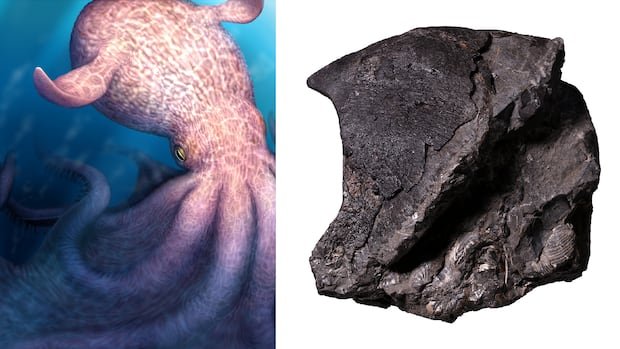

Monstrous octopuses, as huge as modern whales, roamed the oceans during the Age of Dinosaurs, capturing prey with massive tentacles and crushing them with strong jaws, according to fossils from British Columbia and Japan. A recent study published in the journal Science reveals that these creatures, resembling mythical tentacled sea monsters like the Kraken, could reach lengths of up to 19 meters, comparable to the size of a sei whale, the third largest whale species.
Described as possibly one of the largest invertebrates in Earth’s history, one of the two species identified, Nanaimotethis haggarti, has caught the attention of experts. These enormous octopuses demonstrated the ability to consume heavily protected prey with hard shells based on the wear patterns found on their fossilized beaks. The study indicates that Nanaimotethis likely employed its large body and long arms to ensnare prey and its powerful jaws to crush tough structures such as shells and bones.
During an era dominated by large marine reptiles like mosasaurs and elasmosaurus, the presence of these giant octopuses would have introduced new concerns for smaller creatures like fish, sea turtles, and ammonites. The study highlights the significant role of giant invertebrates, specifically octopuses, in the top predator hierarchy of ancient marine ecosystems.
Notably, observations from the study suggest that the octopuses displayed a form of “handedness,” with their jaws exhibiting more wear on one side, hinting at a preference for grasping prey on that side, a trait associated with intelligence. This finding raises questions about the intelligence and behavior of these ancient octopuses compared to their modern counterparts known for their high levels of intelligence.
The study’s fossils, primarily beaks or jaws, were unearthed from rock formations in British Columbia and Hokkaido, Japan, with some specimens housed at the Courtenay and District Museum and Paleontological Centre in Courtenay, B.C. The discovery of these rare fossils sheds light on the evolutionary history of octopuses, challenging existing theories and prompting further investigation into the origins and development of these fascinating creatures.