

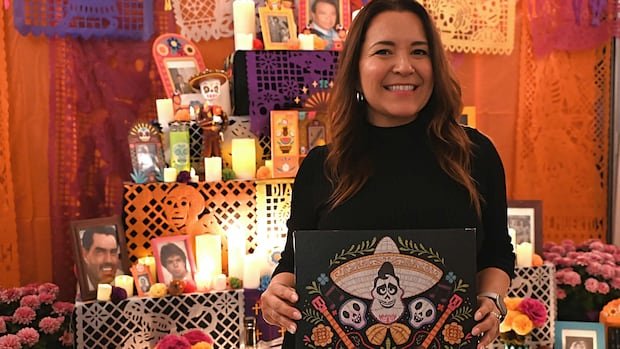

This year, Karla Frey faced challenges while completing her traditional ofrenda at her residence in Boucherville, Quebec. Two months ago, a tragic car accident claimed the lives of her five-year-old neighbor and his mother. The young boy used to visit Frey annually, showing interest in her ofrenda, a tribute she has been creating for 15 years to honor departed loved ones.
Despite the heavy heart from the tragic loss, Frey persevered and meticulously arranged her altar, including photo frames, candles, symbolic bread called pan de muerto, papel picado, mezcal, tequila, and Mexican marigolds known as cempasúchil. Reflecting on the fond memories of the boy, Frey dedicated a part of her ofrenda to him and his mother.
The annual celebration of El Día de Muertos, or Day of the Dead, spans from late October to early November, deeply rooted in Indigenous customs and widely observed in Mexico. It serves as a time for people to remember, honor, and celebrate deceased family members, friends, children, and pets through vibrant decorations and festivities.
In Quebec, the Mexican community upholds these cultural practices, bridging their heritage with their current home. For Frey, who never marked Día de Muertos in Mexico City, the holiday now serves as a meaningful connection to her roots and a means to remember her departed loved ones.
Frey hosts gatherings where friends reminisce about their late family members. She incorporates mezcal, water, and tequila on her altar, believing that the deceased arrive thirsty and guided by the aroma of copal incense and photographs. She emphasizes the significance of honoring the departed to prevent them from fading away into oblivion.
Participating in the Day of the Dead festivities has helped Ferrer appreciate the tradition on a deeper level, particularly after celebrating with Indigenous friends in Oaxaca, Mexico. In Gatineau, Quebec, his altar pays homage to his late grandmother and others, showcasing his profound understanding and commitment to sharing Día de Muertos with the community.
In recent days, individuals eager to experience el Día de Muertos have congregated at UNAM-Canada in Gatineau, where an immersive tour replicates key elements of the Mexican holiday. The event aims to educate visitors on the significance of caves in Indigenous beliefs and the essence of Mexican cemeteries, with scents like copal, cedar, and sage creating an authentic ambiance.
Benitez, a Montreal resident and festival organizer, explains that Day of the Dead has aided him in coping with personal losses and connecting with others. The festival has evolved into a platform for intercultural exchange, featuring themed altars and highlighting the strength of Indigenous communities in preserving ancestral traditions.
As the festival continues to grow, Benitez underscores the importance of cultural dialogue and mutual understanding in Montreal. The event serves as a tribute to the resilience of Indigenous groups and a platform for sharing their heritage with a broader audience.
Despite the somber themes of death and grief, Day of the Dead participants emphasize that the occasion is about remembrance, celebration, and joy. Frey, embodying this sentiment, sees her ofrenda as a way to express her love and hopes that her daughters will continue the tradition when the time comes.
For Frey, the meticulous preparation of her ofrenda each year symbolizes her desire for her loved ones to be remembered with love and celebration, rather than sorrow. She embraces life fully and views the Day of the Dead as a joyful occasion for reflection and connection.