

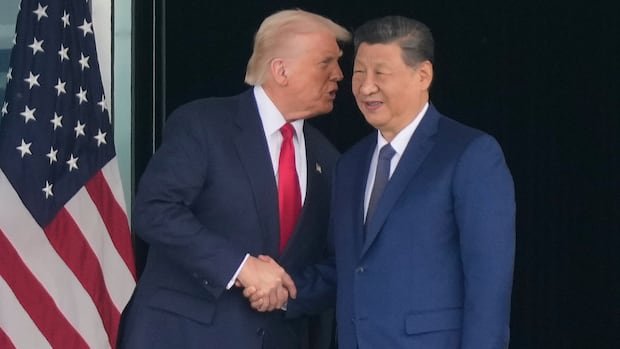

The current deal between U.S. President Donald Trump and China, much like his previous agreements, is short on specifics but heavy on enthusiasm. Trump praised his recent meeting with Chinese President Xi Jinping as extraordinary, giving it a top score of 12 out of 10. He announced that China will make substantial purchases of soybeans and hinted at a potential significant transaction involving oil and gas from Alaska.
While Trump’s remarks are optimistic, experts analyzing the agreement view it more as a temporary truce in the trade war between the world’s largest economies rather than a definitive resolution. The official framework outlined by the U.S. and China essentially involves scaling back some of the punitive measures and retaliatory actions both sides had imposed since Trump’s return to office.
Dennis Wilder, a professor at Georgetown University, indicated that the U.S. and China had engaged in a strategic standoff in recent months, resulting in a stalemate. Wilder emphasized that the current situation represents a pause in the trade conflict and does not signify its conclusion.
As part of the deal, Xi pledged to address the flow of chemicals linked to fentanyl production, prompting Trump to immediately reduce tariffs on Chinese exports to the U.S. by 10 percentage points. The agreement also includes China easing restrictions on rare earth minerals exports and ending its boycott of U.S. soybeans, actions that had sparked backlash within American agricultural communities.
Conversely, the U.S. agreed to postpone stricter controls on high-end semiconductor exports and suspend port fees on Chinese vessels. Analysts like Joe Mazur from Trivium China noted that China’s strategy of retaliatory responses rather than initiating conflicts seemed to have garnered validation through this agreement.
The adjusted tariffs under the deal will result in an average rate of 47% on most Chinese imports into the U.S., marking a significant reduction from the 145% tariff imposed earlier this year. Craig Kafura from the Chicago Council on Global Affairs suggested that Trump’s more conciliatory stance toward China could resonate positively with American public opinion, which has shown signs of disapproval towards tariffs.
In terms of Canada’s position, Kafura highlighted the importance of leveraging trade relationships in negotiating with the U.S. While Canada may not possess the same level of leverage as China, it can still capitalize on specific trade dynamics to strengthen its position during trade discussions. The impact of Trump’s tariffs on Chinese imports has had mixed results, with a decrease in the U.S. trade deficit with China but uncertain outcomes in terms of domestic manufacturing revitalization as promised by the Trump administration.