

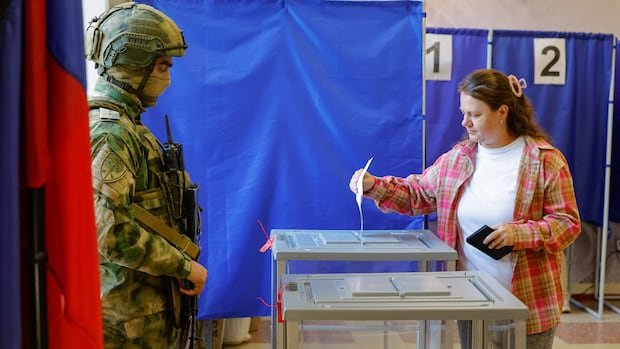

Russians commenced a three-day voting period in their nation’s first parliamentary election during wartime on Friday. The election is anticipated to solidify the Kremlin’s political control as there is minimal opposition. The voting process spans the weekend to encourage participation among the 111 million eligible voters, with the option for electronic voting. Polling stations opened on Friday and are set to close on Sunday. The primary objective for the Kremlin in this parliamentary election, the first since the commencement of the full-scale invasion of Ukraine in 2022, is to emphasize public backing for the war and confer a sense of legitimacy to its actions. The government has taken stringent measures to eliminate any form of dissent or political risk.
Russian President Vladimir Putin addressed the nation before the election, emphasizing the significance of the voters’ choice in showcasing support for the country’s fighters and unity under shared values and historical allegiance to the Motherland. Putin himself voted online on Friday, as reported by Russian state news agencies.
United Russia, the main party aligned with the Kremlin, is poised to maintain its dominant presence in the lower house, the State Duma. Other smaller parties categorized as the “systemic opposition” that typically align with the government on critical matters are also expected to uphold their representation.
This election marks the first time residents from four Ukrainian regions annexed by Moscow after the conflict began have been included in the voting process. Additionally, voting is underway in Crimea, the Black Sea peninsula that was annexed by Russia in 2014. However, authorities in Kyiv have condemned the voting in the Russian-controlled territories as illegal, urging foreign entities and international bodies not to acknowledge the election. They cautioned Ukrainians that involvement in organizing the balloting could lead to legal consequences.
The European Union has also denounced the voting in the Russian-held regions as illegal, emphasizing that the EU will not recognize the elections or their outcomes. Russia’s decision not to invite observers from the Organization for Security and Co-operation in Europe was also highlighted as a point of concern.
The parliamentary election involves voters casting two separate ballots to elect political parties listed on the ballot for half of the Duma’s 450 seats, while the remaining seats are contested in single-seat constituencies where voters select individual candidates. The election follows a period of Ukraine conducting long-range drone strikes on oil refineries, triggering a fuel crisis and causing damage to warehouses of online retailers, exacerbating economic challenges in Russia.
Opinions among Russian citizens vary regarding the election. Some express hopes for an end to the conflict in Ukraine and a desire for peace, emphasizing the safety of their compatriots. Others wish for societal stability and a reduction in economic disparities between the wealthy and the impoverished. The liberal Yabloko party, which was critical of the war, was removed from the ballot by Russia’s Supreme Court, leaving only a few candidates in the single-constituency races. Additionally, some anti-war politicians have faced imprisonment or have fled the country in advance of the election campaign.