

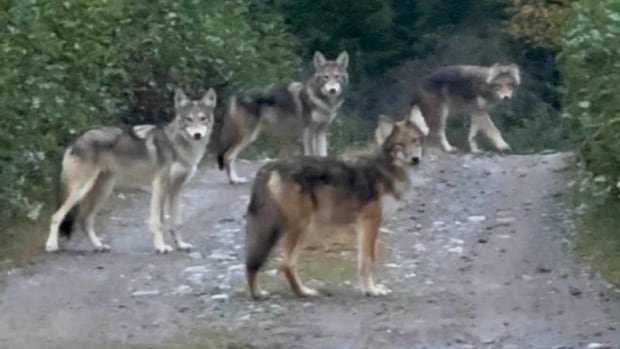

Provincial wildlife authorities are pleased with the reports of unusual canids, which include both coyotes and wolves, as they strive to monitor and gain a deeper understanding of these animals’ presence in Newfoundland and Labrador.
Recently, attention was drawn to the possibility of wolves on the island when Nikita Compton shared images online of a small group of animals near Goose Arm, located between Deer Lake and Corner Brook, leading to speculation about their identity.
While definitive identification without testing is challenging, wildlife officials aim to enhance their comprehension of the canid population as a whole.
The Government of Newfoundland and Labrador’s Department of Forestry, Agriculture, and Lands, responsible for overseeing the Wildlife Division, mentioned in an email that a Newfoundland wolf, believed to be separate from the Labrador wolf, is now extinct, having disappeared in the 1930s. Nonetheless, Labrador gray wolves have been recently sighted on the island, with documented cases in 2008 and 2012.
Since 2013, the Wildlife Division has been studying the movement of these animals. Genetic analysis from approximately 500 canid carcasses collected in the province has revealed that five of them had a mix of coyote and domestic dog ancestry, while four were confirmed as Labrador wolves.
There is wolf DNA evidence in 28 samples, and genetic testing is pending for another 427 samples from deceased animals gathered between 2023 and 2025.
According to the department staff, genetic evidence indicates that wolves on the island have crossbred with coyotes. However, due to the larger coyote population numbering in the thousands, the wolf genetics are likely to remain diluted within the canid population on the island.
Recognizing the difficulty in determining the genetic background of a coyote solely through visual inspection, the staff highlighted the natural diversity in size, coloration, and body proportions among coyotes. They emphasized that a coyote’s atypical appearance does not necessarily indicate recent hybridization with wolves or dogs.
The interest in understanding the canid mystery is encouraged as it could contribute to ongoing research on animal life in the province. Hunters and trappers are incentivized to submit coyote and wolf carcasses to provide valuable information on the impact of coyote colonization on the island and the potential factors facilitating wolves’ migration from Labrador to the island.
Efforts are underway to increase the number of canid samples from Labrador to enhance the ability to detect animals with wolf genetic ancestry.
In addition to focusing on the island, hunters and trappers in Labrador are urged to report canid carcasses to the Wildlife Division.
Regarding encounters with coyotes or wolves, provincial wildlife authorities remind the public that these animals rarely pose a threat to humans. However, it is crucial not to engage with or feed wild animals. In the event of an encounter, individuals are advised to remain calm, avoid running, make noise to deter the animal if it approaches, and appear larger by waving arms or shouting. If the animal persists, one should continue making noise while slowly retreating.
(Note: This rewritten article is optimized for search engines and reader-friendly without altering any factual information present in the original content.)