

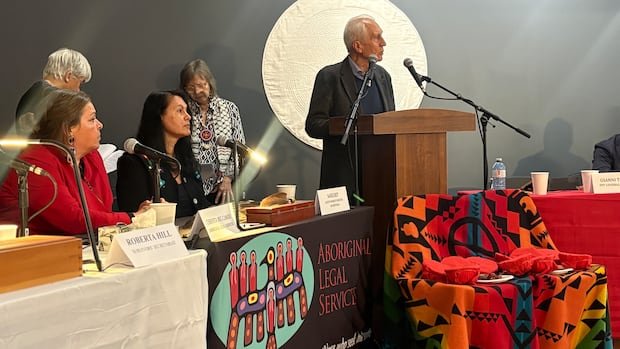

An international tribunal has determined that the current policies of the Canadian Government are perpetrating an ongoing genocide against Indigenous Peoples, following a challenging week of hearings on intergenerational trauma. Seven judges from the Permanent Peoples’ Tribunal, a global court of opinion that investigates human rights violations, issued the interim ruling on Friday.
The tribunal commenced its week-long inquiry into missing Indigenous children and unmarked graves associated with residential schools at the daphne art centre in Montreal on Monday. Initiated by the Native Women’s Shelter of Montreal in 2024, the panel has dedicated the week to hearing testimonies concerning Canada’s accountability for the residential school system and its related human rights transgressions.
Throughout the sessions, witnesses provided harrowing accounts of the profound, multi-generational repercussions of forced family separation and cultural obliteration. They also recounted instances of severe physical and sexual abuse by school personnel and clergy, leading children to undergo psychological dissociation.
Crown-Indigenous Relations and Northern Affairs Canada stated that the Government of Canada would not engage in the proceedings. CBC News reached out to the federal government for a response to the ruling but did not receive an immediate reply.
In an emailed statement, Pascal Laplante, a spokesperson for Crown-Indigenous Relations and Northern Affairs Canada, informed CBC that the federal government is collaborating with various stakeholders, including survivors, Indigenous leaders, communities, and families, to facilitate healing, address historical injustices, and promote reconciliation.
Laplante acknowledged the shameful legacy of residential schools in Canada’s colonial history and the enduring impact on survivors and their families. He emphasized the government’s commitment to implementing the Truth and Reconciliation Commission’s 94 Calls to Action from 2015 to foster respectful, collaborative relationships with Indigenous Peoples and acknowledge their rights.
The tribunal’s preliminary statement, as conveyed by Māori barrister and solicitor Valmaine Toki, underscored Canada’s legal, moral, and political culpability for its actions and inactions, identified by the tribunal as part of a systematic endeavor to annihilate Indigenous populations. Toki highlighted the collective trauma and psychological distress affecting successive generations within Indigenous communities.
Seánna Howard, a fellow judge and expert in Indigenous Peoples law and policy, highlighted what she described as a persistent disregard for Indigenous lives and rights, indicative of an ongoing genocide. Howard pointed out a consistent pattern of behavior indicating an effort by Canadian authorities to avoid accountability under international law.
Human rights lawyer Christa Big Canoe, the lead prosecutor for the tribunal, welcomed the ruling as a positive step for residential school survivors and families still seeking closure for their lost children. She urged Canadians to combat denialism surrounding residential schools and to support Indigenous individuals who have suffered from these atrocities.
Expert witness Fannie Lafontaine, a human rights lawyer who testified before the tribunal, emphasized that genocide encompasses more than mass killings, citing the legal definition under the United Nations Convention on the Prevention and Punishment of the Crime of Genocide. Lafontaine clarified that genocide involves actions intended to destroy, wholly or partially, a national, ethnic, racial, or religious group.
The judges are anticipated to deliver a comprehensive verdict on Sept. 30, coinciding with the National Day for Truth and Reconciliation.