

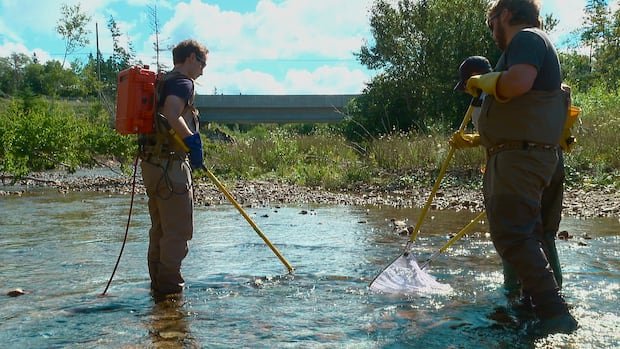

The Margaree Salmon Association in northern Cape Breton has been utilizing electrofishing to monitor fish populations in the Margaree River for the past few years. This method involves using an electric current to temporarily stun fish, allowing crews to safely capture, measure, and identify them before releasing them back into the river.
Michael Fabiano, the conservation coordinator for the association, mentioned that electrofishing operations run from May to late September with a minimal mortality rate of two percent among the thousands of fish processed each season. Fish safety remains a top priority, with crews avoiding electrofishing in high water temperatures.
To ensure safety, crew members wear protective gear such as heavy rubber gloves and chest waders while setting current levels to stun fish for a brief period. Surveying various locations along the 120-kilometer river helps identify productive streams and assess overall fish health, predominantly consisting of trout and Atlantic salmon, with occasional eels and lampreys making up about 95% of the catch.
This season, the association has captured and released around 1,800 fish across nine streams, a decrease from the previous year, which could be attributed to adverse weather conditions that impacted the river’s ecosystem.
Paul MacNeil, the association’s president, highlighted the increased focus on scientific research due to reduced data collection efforts by Fisheries and Oceans Canada over the past five years. To address this gap, the association collaborated with the Chéticamp River Salmon Association to acquire electrofishing equipment, providing more accurate juvenile population data compared to traditional fish counting methods.
The partnership aims to track river health amidst shifting climate conditions, ensuring a comprehensive understanding of fish populations for conservation efforts.