

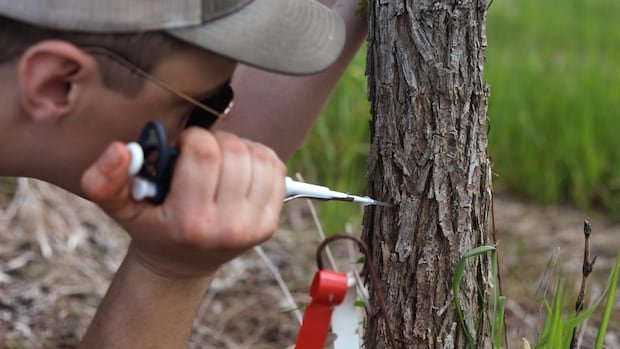

Researchers in Vermont have been deliberately infecting thousands of trees with Dutch elm disease this summer. The aim is to test whether a new generation of elms, bred from disease-resistant survivors, can withstand the fungus transmitted by bark beetles that has been devastating elm populations in the U.S. and Canada for many years. The ultimate goal is to restore areas once abundant with majestic elms, gracing city streets and flourishing along riverbanks.
Gus Goodwin, a senior conservation planner at The Nature Conservancy, expressed the profound impact of the trees’ loss over the years. The experiment in Vermont is part of a broader effort to develop elm strains resistant to Dutch elm disease (DED), with similar initiatives underway in Canada to combat the disease’s expanding threat.
The historical significance of elms is evident in Fredericton, once known as the “City of Stately Elms,” which faced a significant loss of these trees during the disease outbreak in the 1960s and 70s. Today, only a fraction of mature elms remain, underscoring the ongoing battle against DED.
The disease, spread by bark beetles laying eggs in infected trees, obstructs the water-conducting tissues of elms, leading to their rapid decline within a few years of infection. Efforts to control DED involve the prompt removal of infected trees, a practice that has evolved over time to preserve healthy elms with potential disease resistance.
Cities across Canada, from Manitoba to the Maritimes, are witnessing a resurgence of Dutch elm disease, threatening urban forests. Municipalities like Edmonton and Saskatoon are actively managing infected trees to curb the disease’s spread, emphasizing community participation in prevention measures.
Despite the persistent challenge posed by DED, conservationists emphasize the importance of preserving mature elms for their ecological benefits, such as shade provision and stormwater absorption. Restoring elm populations offers a valuable resource in combating climate change impacts and building resilient ecosystems.
Ongoing research projects in North America, like the Elm Recovery Project in Guelph and Fredericton’s city initiative, focus on enhancing DED resilience through selective breeding and cloning of disease-tolerant trees. These long-term efforts aim to develop a new generation of elms capable of coexisting with Dutch elm disease, mirroring the natural evolution seen in European elms.
The journey towards disease-resistant elms is a lengthy process that requires patience and dedication. Scientists anticipate that, if successful, these elms could adapt to DED over time, following a trajectory similar to European elms. While the road ahead may be challenging, the potential benefits of revitalizing elm populations offer hope for a future where these iconic trees thrive once again.