

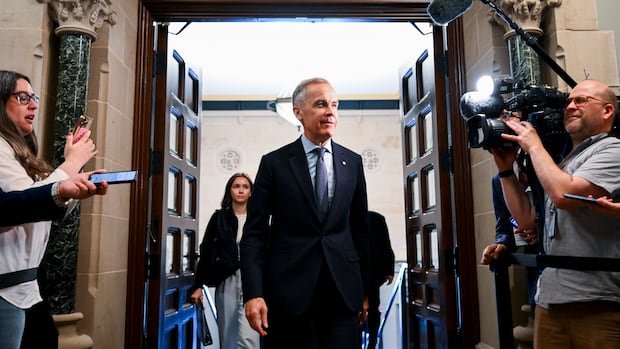

Prime Minister Mark Carney has revealed that the long-awaited national AI strategy of the federal government will finally be unveiled next week after facing several delays recently. Carney made this announcement as he entered a Liberal caucus meeting on Wednesday morning, responding to a query from a reporter about the delayed release by confirming, “It’s coming out next week.”
The upcoming strategy is anticipated to outline Ottawa’s strategies concerning the rapidly advancing technology. The federal government had previously outlined the six key pillars that will serve as the foundation of the national strategy in its spring economic update. These pillars include safeguarding Canadians and democracy, empowering Canadians, fostering AI adoption for shared prosperity, establishing a Canadian sovereign AI foundation, supporting Canadian champions, and building trusted partnerships and global alliances.
The descriptions of these pillars also mention initiatives such as providing AI training and education for all Canadians and implementing modern privacy laws, enhancing online safety, strengthening national AI safety capabilities, and ensuring the security of government systems.
Several executives within Canada’s tech sector have expressed optimism that the strategy will not only bolster the AI industry but also expedite its expansion to position Canada as a leader in AI technology, talent, and companies. Meanwhile, certain provinces are contemplating taking individual measures on AI, like Manitoba, which recently announced a ban on social media and AI chatbots for children under 16. The federal government has indicated a similar consideration in the past.
Moreover, the federal government is actively enhancing its AI industry. During the Web Summit Vancouver event, AI Minister Evan Solomon allocated $66 million to various Canadian artificial intelligence projects to aid them in accessing computational resources for commercialization and scaling their operations. This funding, which will be distributed among 44 projects, is sourced from the federal government’s AI Compute Access Fund, with a total allocation of $300 million.
Additionally, the federal government disclosed plans at the Web Summit to collaborate with Telus on expanding a data center in Kamloops, B.C., and developing two new facilities in downtown Vancouver and Mount Pleasant neighborhood. Following this announcement, there were protests in Vancouver against the data center projects, with residents raising concerns about increased electricity demand and water consumption associated with AI data centers.
Telus has assured that the facilities will operate on 98% clean hydro power, recycle waste energy to heat homes equivalent to 150,000, reduce water usage by 90% compared to traditional data centers, and explore the use of recycled water from B.C. Place stadium. A spokesperson from Solomon’s office mentioned that there are currently no federal funds involved in these projects, but future agreements or contracts could be included based on developments.