

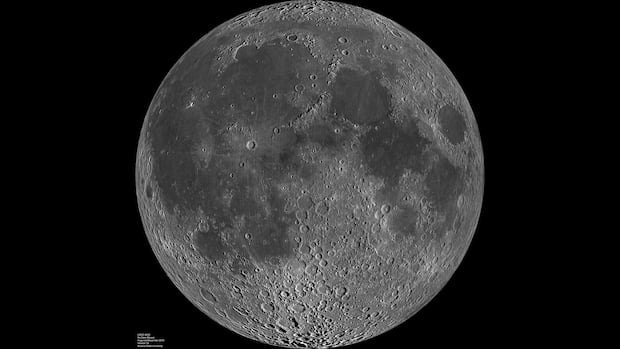

In the early hours of Wednesday, telescopes worldwide will attempt to capture a unique event: an aged rocket colliding with the moon’s illuminated side for the first time ever.
The rocket in question is the second stage of a SpaceX Falcon 9 that launched in January 2025, carrying two commercial lunar landers: Firefly Blue Ghost-1 from the U.S. and ispace Hakuto-R Resilience from Japan. Independent astronomer Bill Gray, who tracks celestial objects, spotted the rocket’s trajectory towards the moon in September of the same year.
Determining the exact orbital path posed challenges due to the subtle gravitational forces of the sun on space objects, but after meticulous calculations, Gray confirmed that the rocket was on a collision course with the moon.
The impact is expected to occur on the moon’s daylight side near its limb. This event is not unprecedented, as previous human-made objects like Apollo upper stages and intentionally crashed items have struck the lunar surface.
Astronomers are urging observatories and amateur stargazers to witness the impact on August 5 at 2:34:32.9 a.m. ET. The best views will be from central and eastern Canada, parts of the U.S., the Caribbean, and South America, as the moon will be favorably positioned.
The rocket, hurtling at approximately 2.43 kilometers per second, is anticipated to eject a plume of debris into space, potentially reaching over a million kilograms before most of it falls back onto the moon. The goal of observing this event is to gather crucial data on these impacts, especially as human space exploration missions to the moon become more frequent.
Astronomer Ben Fernando advises capturing images every fraction of a second to catch the brief impact flash or the lingering plume. The insights gained from this event will help assess the risks posed by human-made impacts on future moon missions and habitats.
As preparations intensify for the August 5 collision, Gray continues to track various space objects, including China’s Chang’e 3 rocket upper stage launched in 2013, to ensure a comprehensive understanding of potential impacts on Earth and the moon in the future.