

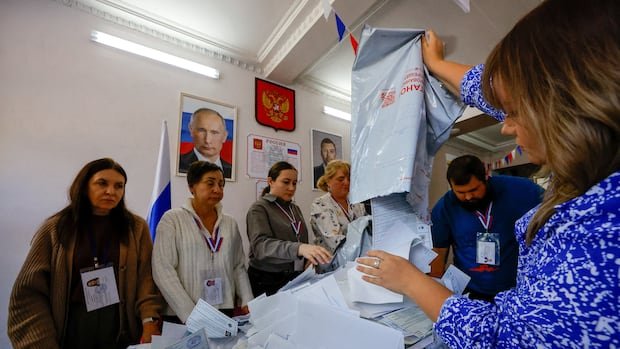

Russia’s dominant political party, United Russia, emerged victorious in the recent parliamentary election, a crucial test of public sentiment regarding the conflict in Ukraine. According to the Central Election Commission, United Russia secured 57.83% of the vote, significantly up from its 2021 performance of 49.8%. The other parties, such as the Communists, LDPR, New People, and Just Russia, which align closely with United Russia on key issues, lagged far behind.
The election results are poised to grant United Russia 355 seats in the 450-seat Duma, ensuring its constitutional majority, as confirmed by the commission. Additionally, three other parties managed to secure parliamentary representation: the Communists with 13.81%, LDPR with 8.98%, and New People with 7.96%. Just Russia fell just below the five percent threshold required to enter parliament but remains hopeful of crossing the barrier, stated Ella Pamfilova.
The voter turnout reached a record high of 59.3%, marking a significant level of public engagement in the election. Notably, international observers from the Organization for Security and Co-operation in Europe were not present to monitor the electoral process.
Ukraine, under martial law, dismissed the Russian election as a “pseudo election,” alleging the exclusion of anti-war candidates and stringent measures against dissent. Amid concerns of restricted freedoms, Yabloko’s leader, Nikolai Rybakov, symbolically defaced his ballot with the party’s name and the slogan “For peace.” Although Yabloko failed to secure national seats, it appeared close to entering the regional parliament in Novgorod.
Russia accused Ukraine of interfering with the election, citing drone attacks on Moscow and cyberattacks on voting systems. The drone strikes resulted in casualties in both Russia and Ukrainian territories, heightening tensions between the two nations.
In a separate development, Ramzan Kadyrov, a key ally of President Putin, was re-elected for a fifth term as Chechnya’s leader with an overwhelming majority. Kadyrov, known for maintaining stability in the region, has faced criticism from international observers regarding election conduct in the past. He remains a staunch supporter of Putin’s policies, especially concerning Ukraine, despite allegations of human rights violations within Chechnya.