

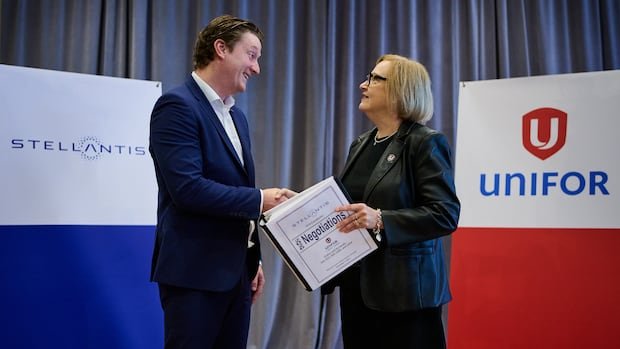

The labor union representing Stellantis workers in Canada has cautioned the automaker against undervaluing its Canadian workforce as contract negotiations with Unifor commenced. Unifor, in its final bargaining rounds with the Detroit Three automakers, adopts a pattern bargaining strategy to establish terms for negotiations with other companies. Despite successfully finalizing agreements with Ford Motor Co. and General Motors earlier in the year, Unifor’s National President, Lana Payne, expressed anticipation for challenging negotiations, citing job security concerns following over 2,000 layoffs at Stellantis’ Brampton assembly plant.
Stellantis recently considered closing and selling the Brampton plant, which had been undergoing retooling for Jeep production before the company halted the process in early 2025, subsequently relocating Jeep Compass production to the U.S. Unifor raised objections, labeling it a breach of the existing collective agreement. Payne emphasized the necessity of rectifying the situation at the Brampton plant by reinstating operations and not proceeding with closure or sale.
Amid negotiations, Stellantis acknowledged the significance of the talks in shaping its future, acknowledging the evolving trade and regulatory landscape impacting the industry. Trevor Longley, Chairman, President, and CEO of Stellantis Canada, highlighted the company’s substantial investments in Canadian operations since 2022, focusing on enhancing manufacturing capabilities and advancing battery technology in Ontario.
The negotiations occur amidst U.S. tariffs affecting local automakers, with a 25% tariff on non-U.S.-built vehicles still in effect. President Donald Trump’s recent tariff threats have heightened concerns, with Unifor stressing the need for Canada to maintain its auto sector presence despite the economic challenges. Larry Savage, a labor studies expert, noted that Unifor is advocating for vehicle production retention in Canada at the bargaining table while concurrently lobbying against trade agreements that could jeopardize the Canadian auto industry.
Unifor’s recent contract ratifications with General Motors saw overwhelming support from members, with wage increases and agreements mirroring those with Ford. The ongoing negotiations with Stellantis and the broader industry not only focus on immediate labor concerns but also address the industry’s long-term viability amidst trade uncertainties.