

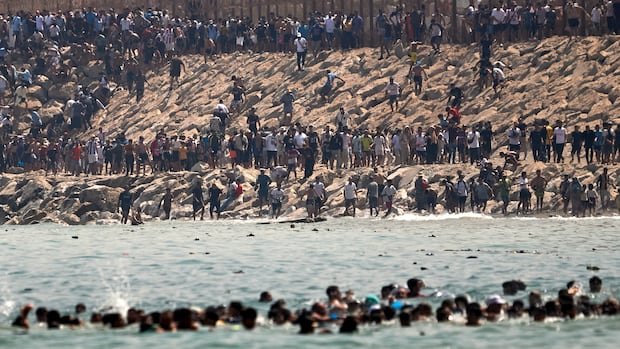

Spain is set to mobilize its military to regain control at its border with Morocco in Ceuta following a surge of migrants entering the small Spanish territory. The decision was made after local authorities in Ceuta sought reinforcements from the central government in Madrid to address a border crisis that escalated on Thursday with a large influx of people breaching the border fence.
In a statement released on Thursday evening, Spain’s government announced that the Armed Forces would assist the Civil Guard in “ensuring security in the city of Ceuta.” Rachid Sbihi, head of the association representing Spain’s Civil Guard officers in Ceuta, described the situation as chaotic, noting that while precise numbers were difficult to ascertain, thousands of migrants were crossing the border, leading to its complete collapse.
Achraf Maimouni, a member of the Moroccan Association for Human Rights in northern Morocco, characterized the situation as exceptional, mentioning that the Tarajal border was unexpectedly opened, allowing people to cross. Video footage depicted crowds, primarily consisting of Moroccans, making their way from Tarajal beach onto local roads, with some chanting “Viva España!” to a photographer from The Associated Press. The motives behind the mass migration to Ceuta remained unclear.
The recent escalation at the Spain-Morocco border follows a surge in migrants attempting to reach the small exclave, primarily through swimming, on the previous day, resulting in the reported deaths of at least three individuals. While Moroccan authorities have not publicly addressed the border crossings, Spain’s Interior Ministry stated that the Moroccan government was closely collaborating with Spain to manage the situation, with Moroccan police intercepting numerous individuals attempting to cross the border.
Fernando Grande-Marlaska, the Spanish Interior Minister, is scheduled to visit Ceuta on Friday to assess the situation. Despite calls from Ceuta authorities to declare a national emergency over migration concerns, Spain’s government noted that it could not do so, attributing the spike in arrivals to a recent Spanish Supreme Court ruling regarding migrants arriving by sea.
Ceuta, located on the northern African coast, serves as a key entry point into Europe for migrants seeking improved economic prospects or refuge from violence in their home countries. The influx of migrants into Ceuta mirrors a similar border crisis in May 2021, when over 8,000 migrants entered the territory in just two days.
Juan Jesús Vivas, the head of Ceuta’s regional government, urged the national government to declare a national emergency citing national security reasons, calling for additional police and military deployment at the border to ensure border integrity and citizen safety. Despite the challenges posed by the overwhelming influx of migrants, both Spain and Morocco agreed to collaborate in swiftly returning all those who entered Ceuta unlawfully.
Ceuta, a historic Spanish possession since 1580, features a diverse population of Christians and Muslims, Spanish and Moroccan residents, coexisting behind a border fence that many migrants from across Africa attempt to breach in search of a better life in Europe.