

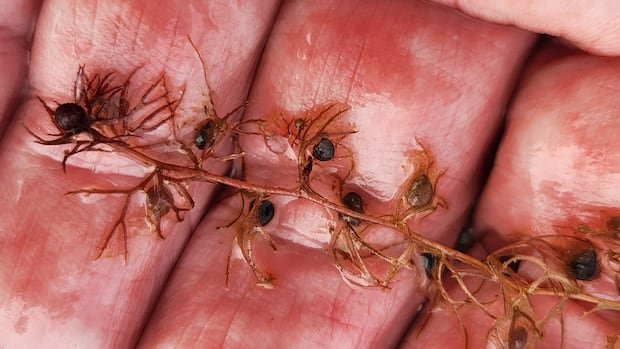

Plant enthusiast Klaus Koehler made a rare discovery at Sylvia Grinnell Territorial Park near Iqaluit in July, stumbling upon a plant species rarely found in the Arctic. Koehler believes this finding could signify a potential increase in invasive species in Northern environments as temperatures rise.
During his walk, Koehler reached into a pond and retrieved a brownish weed-like plant known as bladderwort. Despite its inconspicuous appearance to the untrained eye, Koehler recognized the plant’s significance. The carnivorous bladderwort is adorned with small black bladders containing partially digested flies, a feature typically observed in more temperate regions and seldom in Arctic landscapes.
This discovery echoes a previous sighting in 2012 when scientists encountered bladderwort near Kimmirut, approximately 120 kilometers southwest of Iqaluit. Subsequent expeditions to the Arctic by the research team unveiled over 30 new plant species in the region.
Koehler postulates that the emergence of bladderwort could be linked to shifting climate patterns. While the Arctic has historically hosted minimal invasive species due to harsh conditions, the warming climate is fostering a more welcoming environment for non-native vegetation. He anticipates a shift in the Arctic ecosystem as summers lengthen and winters shorten, facilitating the expansion of both invasive and indigenous plant species.
Paul Sokoloff, a senior research assistant at Ottawa’s Museum of Nature, shares Koehler’s concerns. Sokoloff, part of the 2012 discovery team, warns of the potential threat posed by invasive species introduced through various means, including bird migration and human activity.
While Koehler’s finding may not pose an immediate threat, Sokoloff emphasizes the need to monitor and mitigate the influx of invasive species into the Arctic. A study by scientists from the Norwegian University of Science and Technology identified over 2,500 plant species with the capacity to invade Arctic ecosystems, disrupting native flora.
To further investigate the bladderwort’s expansion northward, Koehler plans to submit a sample to the Museum of Nature for detailed analysis. This collaborative effort aims to enhance scientific understanding of the plant’s behavior in response to changing environmental conditions.