

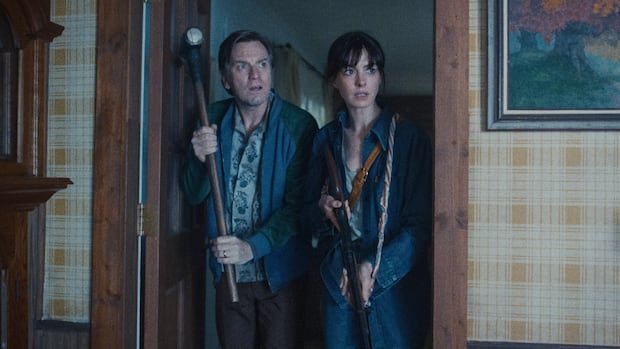

In 1982, the main concerns of a homemaker may revolve around their kids engaging in teenage antics, a distant husband shirking household duties, or peculiar occurrences like strange lights, intense heat, and even a dinosaur tail in the backyard.
Enter the universe of Oak Street, as portrayed by housewife Denise (played by Anne Hathaway) and filmmaker David Robert Mitchell in “The End of Oak Street.” This eerie tale unfolds in a neighborhood mysteriously transported back to the late Jurassic era, challenging a subdued yet discontent family to confront both unearthly creatures outside and their internal disconnections.
With a Spielberg-esque essence intertwined with Stephen King’s narrative flair, the film portrays the Detroit family led by the aloof yet caring father Greg (portrayed by Ewan McGregor), the melancholic prodigy elder sister Audrey (played by Maisy Stella), and the boy-next-door younger brother Brian (enacted by Christian Convery) as a quintessentially American household.
While seemingly a heartfelt homage to ’80s cinema, “Oak Street” is criticized for lacking the depth and purpose present in its cinematic inspirations. The movie, although entertaining and somewhat innovative, falls short of the blockbuster status it was hailed for, feeling more like a superficial mimicry of Spielberg’s classics without grasping their thematic essence.
The narrative, overshadowed by dinosaur encounters and lacking character development, leads to repetitive action sequences, diminishing the impact of the film. Despite its visual spectacle and nostalgic appeal, “The End of Oak Street” fails to deliver a compelling storyline that resonates with the audience on a deeper level.
While the film attempts to capture the essence of iconic movies, it falls short in creating a meaningful connection with the characters, leaving viewers detached from the protagonists’ struggles. The lack of a clear message or purpose raises questions about the film’s overall impact and the director’s intent in crafting a compelling narrative.
In a cinematic landscape where originality and depth are valued, “The End of Oak Street” struggles to offer a fresh perspective or resonate with audiences beyond its superficial charm. As viewers navigate through the film’s borrowed aesthetics and familiar themes, the movie’s lack of substance becomes evident, prompting reflection on the importance of storytelling in cinema.
Despite its visual allure and nostalgic nods to past cinematic gems, “Oak Street” ultimately falls short in delivering a cohesive and resonant narrative that transcends its surface appeal. As audiences grapple with the film’s shortcomings, it raises questions about the evolving landscape of filmmaking and the balance between homage and originality in storytelling.