


A monarch butterfly hailing from Manitoulin Island, Ontario, has gained local fame after completing a remarkable journey across North America that culminated in Mexico this month.
Covering over 3,300 kilometers in a span of 70 days, this magnificent creature accomplished something that scientists once deemed impossible: crossing two Great Lakes.
The young female butterfly, designated as MAN26021, was one of many tagged by researchers from Environment and Climate Change Canada and the Canadian Wildlife Federation on Manitoulin Island in late August.
This tagging was part of a research initiative aimed at studying the migratory behaviors and flight patterns of these butterflies.
Tags affixed to their thorax transmitted data via solar-powered radio transmitters.

A monarch butterfly tagged with a solar-powered radio transmitter, a tiny device weighing less than a grain of rice. (Manitoulin Nature Club)
Joe Shorthouse, a retired entomologist from Laurentian University and veteran butterfly researcher, mentioned that he and his team were able to monitor MAN26021 using the Project Monarch app.
This young monarch, approximately the same weight as a paperclip, successfully flew over Lake Huron and Lake Michigan before navigating through the U.S. to arrive at the Reserva de la Biosfera Mariposa Monarca overwintering site, situated around 100 kilometers northwest of Mexico City.
Shorthouse described it as a remarkable achievement in the realm of nature.
“For the first time in history, we discovered that they can traverse the Great Lakes,” he remarked. “This revelation is a significant surprise to everyone.”
-
What on Earth
Eddie’s dead: What one monarch’s ill-fated journey can teach us about migration patterns
-
1st of 29 monarch butterflies tagged on Canadian Prairies reaches Mexico after perilous migration
Throughout its two-and-a-half month journey, the butterfly likely evaded numerous hazards that typically claim the lives of monarchs, including traffic and inclement weather, Shorthouse pointed out.
Considering the additional challenge of flying over two Great Lakes, the improbability of this accomplishment becomes even more astonishing, he stated.
“This is one of the most enigmatic and intricate stories in the world that remains largely unexplained. How can it fly such vast distances, and what guides them on their path?”
The Manitoulin Nature Club, which has been active on the island for 47 years, expressed pride in being the starting point for this butterfly’s extensive journey.
Phyllis Cacciotti, the club’s president, remarked that this achievement serves as a testament to the incredible power of nature, even in its smallest forms.
“It’s incredibly inspiring. They are true warriors,” she noted.
“We are fortunate here on Manitoulin Island due to our rich biodiversity, which we must protect and preserve for future generations.”
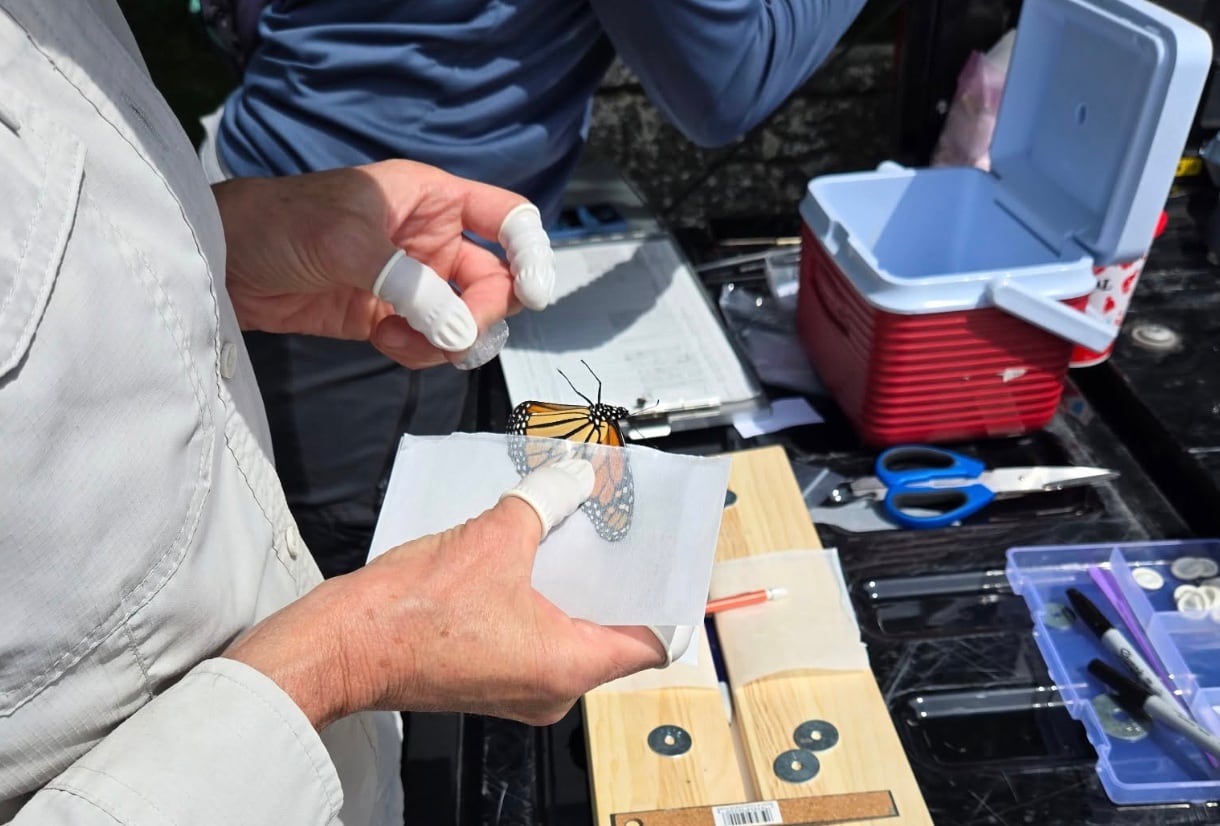
Monarch butterflies were measured and tagged on Manitoulin Island over the summer before journeying towards Mexico for the winter. (Manitoulin Nature Club)
The Manitoulin butterfly is now among thousands that are settling in for winter among the oyamel fir trees in the mountains of Mexico.
Shorthouse expressed hope that this prized butterfly will mate in the spring and migrate as far north as Texas, where she will lay her eggs and subsequently perish.
However, her legacy will endure.
The offspring of the butterfly are expected to migrate northward, potentially reaching the upper U.S. states, before repeating the same cycle.
“It will be the grandchildren of MAN26021 that will be spotted on the shores of Manitoulin Island in May of 2027.”