

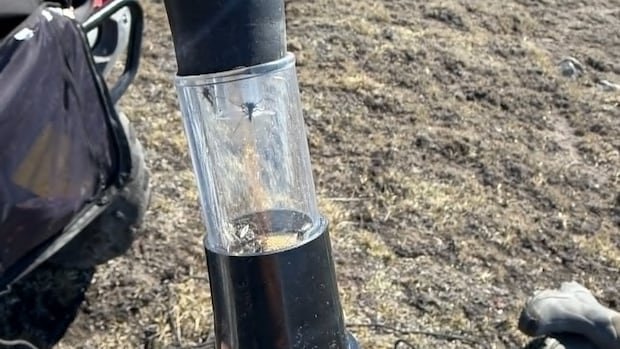

Last autumn, while on a hunting trip near Kugluktuk, Nunavut, Beau Taptuna and his family made a troubling discovery. Taptuna observed several dead caribou with no signs of gunshot wounds on the land. Suspecting an insect-borne parasite as the cause of death, Taptuna, a summer science ranger in Kugluktuk, has been involved in the Kitikmeot biting insect monitoring program. This federally-funded initiative focuses on studying insects, the parasites they carry, their impact on animals, and monitoring the changing biodiversity of biting insects such as black flies and mosquitoes due to climate variations.
Since its inception three years ago in Kugluktuk, the program has expanded to Gjoa Haven, Kugaaruk, and Cambridge Bay in Nunavut. Taptuna employs various nets to capture insects for analysis at the University of Guelph and the University of Calgary laboratories.
According to Danielle Nowosad, a postdoctoral fellow at the University of Calgary, the project has revealed that insects are emerging earlier due to rising temperatures, and there is a higher diversity of insect species compared to a previous survey conducted in 2010-2011. Nowosad predicts an increase in population abundance, leading to higher mosquito and biting insect numbers and the potential introduction of new species.
Recent samples collected in Kugluktuk contained nearly 300 insect species. Nowosad’s climate data-based species distribution model indicates a significant expansion of the geographical region suitable for black fly breeding in the North in the coming decades.
The monitoring program, initiated following a request from a hunters and trappers organization’s annual general meeting in 2022, is community-driven. It involves extensive consultations with community members, elders, and harvesters.
Hannah Zikalala, a project manager in Cambridge Bay, emphasizes the program’s significance in safeguarding caribou populations from insect-borne parasites, which could impact the animals’ size and health. Zikalala stresses the importance of preserving traditional meat sources for future generations.
Nowosad highlights the program’s focus on monitoring parasites and the surprising diversity discovered through advanced genomic techniques. Community discussions have also raised concerns about the potential introduction of new biting insects from wildfires in southern regions.
The program is set to continue for a few more years, with a research paper scheduled for release in the fall. Taptuna underscores the program’s critical role in protecting not just insects but also the interconnected ecosystem of animals that sustains their way of life.