

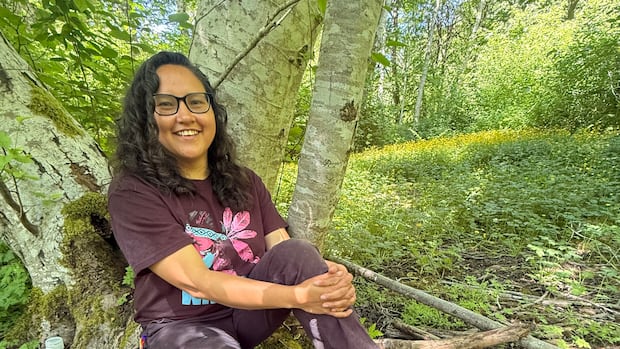

Burn scars remain visible on the oldest Douglas fir trees on southern Vancouver Island, as noted by Tiffany Joseph, who leads the XAXE TEṈEW̱ Sacred Land Society’s Indigenous land restoration and stewardship initiative.
This serves as proof that the W̱SÁNEĆ communities have engaged in forest burning for many generations, she remarked.
“Our ancestors, through their keen observation over thousands of years, discovered that naturally occurring burns led to a greater abundance and higher quality of food and medicine,” Joseph explained.
She added that once her ancestors recognized fire as a natural land management tool, they began to adopt it for their own purposes.
“They transformed existing meadows into managed landscapes through burning over the centuries,” she stated.
However, since 1904, when the Vancouver Portland Cement Company established a facility at Tod Inlet and began extracting lime in the area, the land has not received the necessary care, according to Joseph.
“Our people need to return because the land longs for us,” she expressed.
Joseph emphasized the importance of consulting elders regarding the team’s burning methods. This year, she enlisted Joe Gilchrist, a wildland firefighter with over three decades of experience from Skeetchestn, to educate them on cultural, prescribed, and controlled burning practices aimed at preventing wildfires.
“A well-managed forest will feature trees that are adequately spaced, with lower limbs trimmed to avoid contact with the ground,” Joseph noted.

Tiffany Joseph mentioned that cultural burning practices involve a spiritual connection to fire. (Emilee Gilpin/CBC)
There are initiatives underway to restore Indigenous firekeeping practices throughout British Columbia. William Nikolakis, an associate professor at the University of British Columbia’s faculty of forestry and environmental stewardship, noted that these ecosystems are reliant on fire.
Nikolakis collaborates with the Gathering Voices Society and the Yunesit’in of the Tŝilhqot’in Nation, focusing on the impact of Indigenous stewardship on landscapes.
“We are dealing with significantly damaged landscapes that have been heavily impacted,” he remarked.
“It is about managing landscapes in ways that yield positive outcomes for both people and ecosystems,” he added.
His collaboration with First Nations fire stewards began in 2019, and he emphasized that the insights from Indigenous communities regarding the land’s needs are invaluable. Currently, it’s centered on “learning through practice.”
“We aim to avoid overheating soils due to fire, and we do not want to harm saplings… we prefer to burn when the ground is frozen or during periods with expected snow or very cold nights,” he explained.
Furthermore, modeling indicates that fire spreads more slowly and with lower intensity in areas that have undergone cultural burning.
Nikolakis mentioned that preliminary findings from his research—still pending peer review—suggest that plants subjected to low-intensity burns yield five times as many berries and possess significantly more nutrients compared to unburned sites.

The First Nations’ Emergency Services Society of B.C. states that cultural burning, shown here in 2025, involves setting low-intensity fires in manageable areas to eliminate flammable materials. (First Nations’ Emergency Services Society of B.C./YouTube)
“We are observing natural regrowth occurring, and the community is noticing an increase in deer and the return of elk to the area,” he added.
The research supports this observation, with 74 cameras deployed across the landscape monitoring vegetation and wildlife.
“Indigenous fire stewardship reflects the connection between people and the land, allowing them to learn and understand when fire is necessary in that environment,” Nikolakis stated.
He regards this as a crucial aspect of restoring healthy landscapes in British Columbia.
Joseph is among numerous Indigenous land stewards revitalizing cultural practices and imparting that knowledge to future generations.
“By caring for the forest, we are not only preventing wildfires but also ensuring that when our people feel safe to return, they will find a beautiful environment awaiting them,” she concluded.