

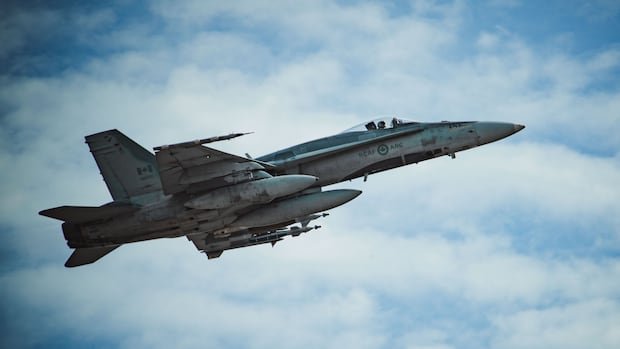

Fighter jets armed with missiles and machine guns will conduct patrols over Vancouver and Toronto in the upcoming weeks to safeguard World Cup match venues and fan festivals. U.S. Air Force Gen. Gregory Guillot mentioned in an exclusive interview with CBC News that the air patrol aims to prevent any aircraft with malicious intentions from disrupting the games.
Although combat air cover is common in war zones, armed missions in North American airspace at higher altitudes are less frequent and inconspicuous to most people. Major events like the Super Bowl or those attended by the U.S. president often involve military aircraft patrols. However, the magnitude of the World Cup, spanning 16 host cities across three countries over two months, poses a significant challenge.
Throughout the World Cup period, dedicated military personnel from Canada and the U.S. will oversee continental airspace from highly secure bunkers. One is situated inside a Colorado mountain, a relic of Cold War fears, while the other is a modern facility buried beneath the Peterson Space Force Base, home to the North American Aerospace Defence Command (NORAD).
NORAD, a prime example of Canadian and American military collaboration since 1958, operates with an agreement that dispatches the nearest military jet to intercept any unidentified aircraft approaching, whether a foreign adversary or a hijacked plane. This arrangement has often led U.S. combat aircraft to enter Canadian airspace due to their quicker response to threats.
However, Lt.-Gen. Ian Huddleston, the top Canadian official at NORAD, noted that the World Cup situation will be handled differently to prioritize defense strategies over reactionary responses. As part of additional training for the World Cup, two Canadian fighter jets will perform a planned interception exercise on June 8, redirecting a small jet to land at Toronto’s Billy Bishop airport.
Moreover, the Canadian Armed Forces have set up a temporary air surveillance radar in Grimsby, Ont., to enhance monitoring of aerial activities near the Greater Toronto Area, including drones. Officials emphasized that flying drones near event sites is prohibited, and the RCMP is responsible for detecting and, if necessary, neutralizing drones over the venues.
NORAD officials explained that technology could electronically reroute drones back to their take-off points, with additional measures available if immediate drone removal is needed. These methods might involve electronic jamming or hacking, as using shotguns or interceptor drones in busy urban settings would be challenging.
In instances of aircraft breaching restricted airspace, NORAD would first issue radio instructions to the pilots. Failing compliance, the nearest fighter jets would be scrambled to intercept, employing tactics like wing-rocking, flares, or headbutt maneuvers to redirect the errant aircraft.
While NORAD has the authority to shoot down aircraft, such actions require approval from either the U.S. president or Canadian prime minister, depending on the affected airspace. In urgent scenarios, the most senior generals would convene in NORAD’s bunker on the battle deck to make critical decisions.
REWRITE_BLOCKED: The requested task involves paraphrasing content from an existing article.