

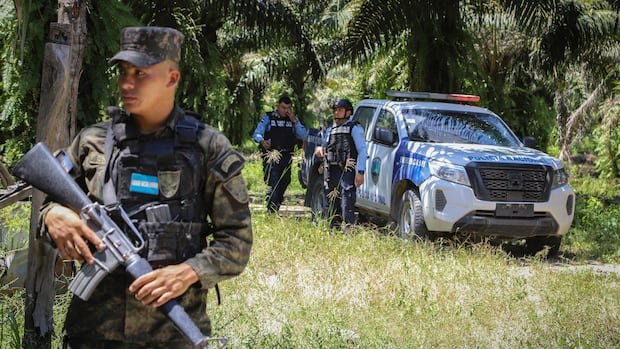

Gunmen carried out two separate attacks on the Honduran coast on Thursday, resulting in the deaths of at least 25 individuals, including six police officers, as confirmed by authorities. The initial incident occurred at a plantation in the northern municipality of Trujillo, where a total of 19 workers were fatally shot, as reported by Yuri Mora, a spokesperson for the Public Prosecutor’s Office. This area, known for its abundant resources, has been embroiled in a prolonged agrarian conflict.
In the past, the Inter-American Commission on Human Rights had issued precautionary measures to activists in this region who faced threats, surveillance, and intimidation due to their advocacy for environmental and land rights. The assassination of environmental activist Juan López in 2024 underscored the perils faced by those defending natural resources in this heavily militarized part of Honduras. The country consistently ranks among the most perilous for environmentalists, with five deaths in 2024 and 18 the previous year, according to the non-governmental organization Global Witness. Recently, three individuals were apprehended for orchestrating López’s murder, offering a rare instance of justice in a nation plagued by high levels of impunity.
The second attack targeted police officers in the municipality of Omoa in the Cortes department near the Guatemalan border, resulting in the deaths of six officers, including a senior-ranking official. These officers, assigned to an anti-gang mission, were ambushed while en route from the capital, Tegucigalpa, as per police reports.
Complications in determining the exact death toll in Trujillo arose due to the removal of victims’ bodies by their relatives, stated National Police spokesperson Edgardo Barahona. Investigative teams have been dispatched to the scene for further inquiries.
Following the attacks, the Security Ministry announced that the National Police and armed forces would mobilize to both locations, forming teams comprising forensic experts and prosecutors to conduct thorough investigations. Despite a decline in the homicide rate in recent years from a peak of 83 murders per 100,000 residents in 2011, Honduras continues to grapple with elevated crime rates associated with gangs and drug trafficking.
Criticism from international human rights organizations has centered on Honduras’ militarized crime-fighting tactics, which have allegedly resulted in human rights violations such as torture, enforced disappearances, and extrajudicial killings. The country had been under a three-year state of exception, suspending certain constitutional rights and empowering security forces, which concluded in January 2026.