

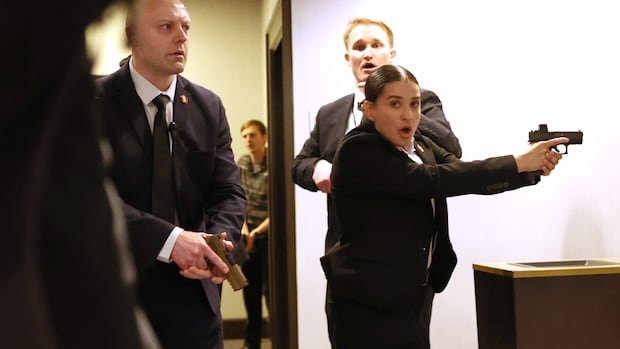

A surge of conspiracy theories inundated social media following reports of gunfire at the Washington Hilton hotel during the White House Correspondents’ Dinner on Saturday. This trend, although anticipated, is notable for the range of theories originating from various political perspectives, including liberals, progressives, and critics of President Donald Trump.
Carmen Celestini, a researcher at the University of Waterloo focusing on disinformation and extremism, observed a heightened prevalence of conspiracy theories, particularly on the political left. The event, witnessed by numerous journalists, unfolded with real-time updates but faced challenges in confirming details due to the shooter’s location within the hotel.
Following the incident, speculations emerged suggesting that the shooting was orchestrated for political motives, further fueled by actions taken by U.S. authorities post-event. Notably, Democratic congresswoman Rep. Jasmine Crockett questioned the frequency of assassination attempts on a sitting president, prompting speculation on the reasons behind such occurrences.
On social media platforms, claims surfaced alleging that the incident was staged to divert attention from contentious issues like the Iran conflict or to advocate for the completion of the White House ballroom. Trump supporters swiftly echoed these sentiments, leading to suspicions of a coordinated effort among influencers.
The push for the ballroom’s construction continued post-shooting, with Trump emphasizing its importance and linking it to enhanced security measures. The Justice Department leveraged the incident to pressure preservationists, while Republican lawmakers sought legislation to expedite the project using public funds, citing security concerns.
Unusual incidents and remarks during the event sparked further theories, including suggestions of foreknowledge and time travel involvement. These narratives reflect a broader trend of distrust and disillusionment among segments of the population, exacerbated by perceived discrepancies between official narratives and everyday realities.
Experts like Celestini and Jen Golbeck underscore the allure of conspiracy theories in a climate of distrust and information overload. The proliferation of such narratives highlights the challenges in navigating a complex media landscape, where individuals may gravitate towards simplified explanations that align with their beliefs.
In conclusion, the proliferation of conspiracy theories surrounding the White House Correspondents’ Dinner shooting underscores broader societal issues around trust, perception, and the interpretation of information in today’s digital age.