


Over the last year, a nonpartisan group traveled across various regions to discuss and decide on the demarcation of electoral boundaries in Alberta. The Alberta electoral boundaries commission, which is reconvened every eight to 10 years, is responsible for determining the constituency groupings for electing members to the Alberta Legislative Assembly. In March, the commission presented a comprehensive report running into hundreds of pages.
In a unique move, the final report of the five-member commission included two distinct maps proposed by the majority and minority members. Justice Dallas Miller, the commission’s chair, recommended adopting the majority report to the legislature. However, he suggested increasing the legislative seats from 89 to 91 if the majority report was not adopted. The opposition NDP criticized any deviation from the majority report as “election rigging,” while the UCP aimed to safeguard rural representation.
To address the issue, the UCP established an all-party committee within the Alberta legislature to revise the boundaries. However, the committee faced obstacles when Alberta’s acting chief justice declined to assist in appointing retired and sitting judges for the boundary redrawing process. The ongoing debate is expected to continue in the Alberta legislature until a final report is anticipated in November.
The commission’s report provides insights into the potential electoral impacts based on different boundary scenarios. By analyzing the previous election results under the proposed boundaries, it was observed that the UCP would have varying seat outcomes depending on the majority or minority maps.
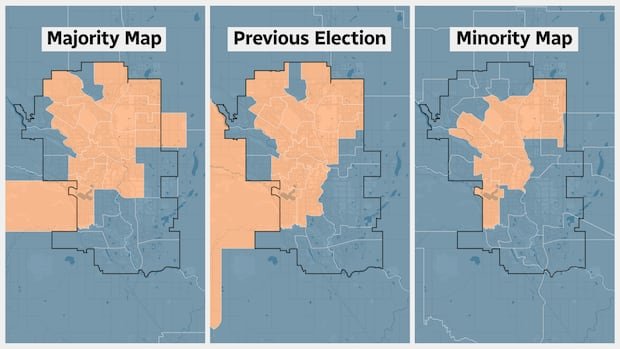
The proposed changes have a significant impact on Calgary, a key battleground. The majority report suggests adding two seats to Calgary, favoring the NDP, while the minority report divides Calgary into 29 ridings, with a UCP majority in most “rurban” or hybrid ridings. Furthermore, Edmonton, traditionally an NDP stronghold, could see changes in seat allocations under the different boundary proposals.
The UCP’s dominance in rural Alberta is also a focal point, with variations in seat outcomes under the majority and minority boundary proposals. Notable changes include the redistribution of ridings in Lethbridge and Red Deer, potentially altering party representation in these areas.
The debate surrounding the electoral boundary redraw is intensifying, with contrasting viewpoints on the best approach. The final decision on the boundaries will have far-reaching implications for the political landscape of Alberta.