

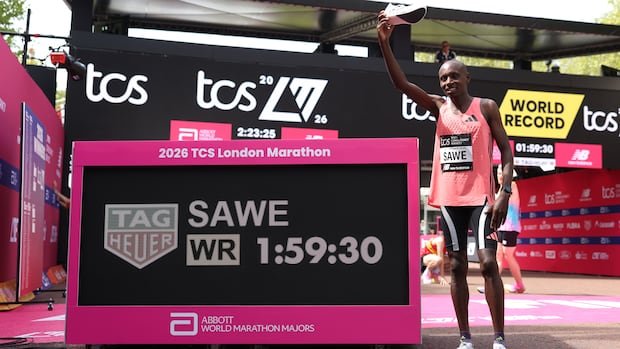

A duo of distance runners from Africa achieved a remarkable feat in the world of sports on Sunday by breaking the elusive two-hour barrier in the 42.2-kilometer marathon. Sabastian Sawe from Kenya emerged victorious in the London Marathon with a remarkable time of one hour, 59 minutes, and 30 seconds, surpassing the previous men’s world record by a staggering 65 seconds. He outpaced Ethiopia’s Yomif Kejelcha, who completed his first marathon in 1:59.41.
In a post-race interview, Sawe expressed that his achievement was not just for himself but for everyone in London that day. Jacob Kiplimo of Uganda secured the third position with a time of 2:00.28, which was seven seconds faster than the previous world record set by Kelvin Kiptum of Kenya. This marked a historic moment as all three men on the podium broke Kiptum’s three-year-old record.
The marathon legend has it that the race distance mirrors the run of a Greek soldier from Marathon to Athens to convey a military triumph in ancient times. Sawe’s impressive performance on the relatively flat London course under favorable weather conditions saw him clock a faster second half, completing it in 59:01. He and Kejelcha surged ahead after the 30 km mark, with Sawe making a solo break in the final two kilometers, cheered on by enthusiastic fans as he sprinted to the finish on The Mall.
Acknowledging the support from spectators, Sawe emphasized the significant role they played in boosting his morale during the race. The defending champion expressed gratitude towards the massive crowds that lined the streets of London to witness a remarkable display of athleticism, raising the fundamental question in the sport of running – how fast can a person go?
The breaking of the two-hour marathon barrier has set a new benchmark in the sport, echoing the historic achievement of Roger Bannister’s sub-4-minute mile in 1954. The marathon distance continues to captivate the running community, with the quest for the elusive two-hour mark captivating the world’s top athletes and sports gear manufacturers for the past two decades.
While Eliud Kipchoge unofficially achieved the sub-two-hour marathon milestone in 2019, the recent feat by Sawe has now rewritten the record books on a less challenging marathon course. The ongoing evolution of track and field records also includes iconic achievements like Usain Bolt’s 100-meter dash, Mike Powell’s long jump record, and Marita Koch’s 400-meter sprint.
Advancements in training methods, nutrition, and equipment, particularly the innovative shoe technologies, have played a pivotal role in pushing the boundaries of human performance in marathons. The ongoing debate surrounding the impact of shoe technologies on athletic performance has intensified, with the focus on producing lighter and more responsive footwear for runners.
In the women’s race, Ethiopia’s Tigst Assefa clinched victory in the fastest-ever women’s-only marathon with a time of 2:15:41, defending her title while falling short of Paula Radcliffe’s course record set in 2003. The event witnessed a historic moment as three women completed the marathon in under two hours and sixteen minutes.
The wheelchair races also saw remarkable performances, with Marcel Hug claiming his sixth consecutive men’s title and Catherine Debrunner securing victory in a tight finish to defend her title against Tatyana McFadden. The London Marathon showcased exceptional athleticism and record-breaking achievements across various categories, reaffirming the enduring appeal and competitive spirit of the sport.