

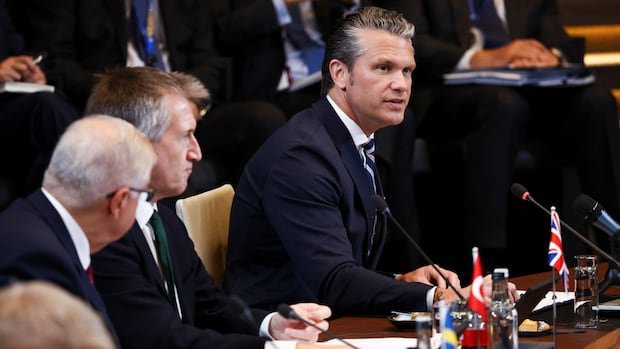

U.S. Secretary of War Pete Hegseth criticized NATO allies for imposing limitations on American access to European bases during potential conflicts with Iran and warned that the Pentagon will review U.S. military contributions to the alliance. The evaluation aims to gauge how quickly and effectively European members are assuming responsibility for securing the continent. Hegseth emphasized that the assessment will also consider defense spending adequacy, along with his pointed remarks on European gender and migration policies during a passionate address to NATO counterparts in Brussels.
He stressed the importance of NATO transitioning towards Europe taking the lead in its defense efforts, noting that some countries may fall short in the review while others excel. Hegseth’s assertions regarding current European policies were deemed inaccurate, as European nations, like the United States, have reinforced border security measures. Following his critical remarks, Hegseth abruptly departed the meeting, leaving NATO Secretary General Mark Rutte to manage the surprised allies who heard the speech in silence.
In addition to the review, the Pentagon recently reduced the list of forces designated for NATO in emergencies, prompting European allies to scramble for equipment to fill potential gaps. The Trump administration insists on preparing for dual conflicts and seeks increased military resources to address potential clashes with China in the Indo-Pacific region.
After the meeting, Rutte defended allies who have substantially boosted defense spending by $90 billion US through 2024 while acknowledging some of Hegseth’s arguments. He emphasized the importance of assessing the U.S. role in terms of force posture and potential adjustments. Rutte indicated that the review process would span several months.
Rutte anticipates that allies will present “credible” plans to meet NATO’s updated defense spending targets at the upcoming summit in Ankara, Turkey, aiming for five percent of GDP by 2035. The Pentagon has criticized Canada for not submitting a plan yet, with Defence Minister David McGuinty stating that the country is actively developing the necessary strategies to reach the outlined spending targets. Canada recently surpassed the two percent GDP threshold for defense spending and is progressing towards meeting the 3.5 percent goal and the ultimate five percent target by 2035.