

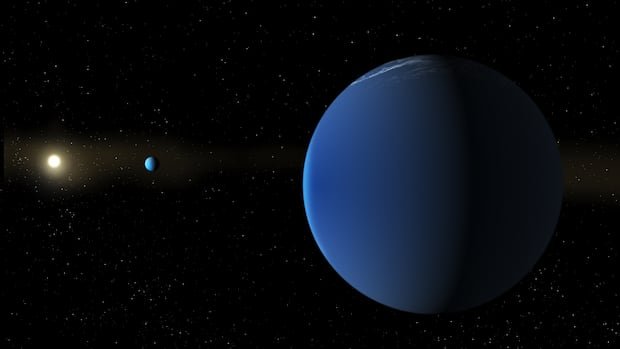


About 1,113 light years away from our planet, in a single-star system, exist two Jupiter-sized planets with the density of cotton candy.
These newly found exoplanets are classified as “super-puffs,” characterized by their remarkably low density.
Leading the study on these unique planets, University of Oxford astrophysicist George Dransfield likens them to “a nice blob of shaving foam straight from the can.”
How these puffy celestial bodies, 1,000 times larger than Earth, evolve into planets remains a mystery according to co-author Antoine Petit, a mathematician from France’s Centre National de la Recherche Scientifique, in a conversation with As It Happens host Nil Koksal.
“There’s still much theoretical exploration required to unravel how these planets maintain such immense size,” Petit stated.
The research unveiling these findings was released in the Monthly Notices of the Royal Astronomical Society on Thursday.
Understanding the Super-Puff Phenomenon
Super-puffs are considered rare cosmic occurrences. Among NASA’s nearly 6,300 confirmed exoplanets, less than 40 are classified as super-puffs.
Dr. Lisa Dang, an astrophysicist at the University of Waterloo in Ontario, finds the discovery of two super-puffs orbiting the same star particularly noteworthy.
These planets pose a mystery as typically, planets with significant mass are denser, not larger.
According to Dang, “The existence of these super-puff planets is intriguing because it suggests the presence of an internal mechanism that inflates them.”

There are two prevailing theories explaining the existence of these giant super-puffs, outlined by Nicolas Cowan, a physics and planetary sciences professor at McGill University in Montreal. These theories revolve around the age and temperature of the planets.
Cowan elaborates, “The size of a planet is greatly influenced by its temperature due to the compressibility of gas. Therefore, altering the planet’s internal temperature can affect its size.”
Young super-puffs may not have had sufficient time to cool down and compress internally, while older super-puffs might sustain continuous heat, possibly from tidal heating caused by gravitational interactions with other celestial bodies.
However, Cowan suggests that if these newly discovered planets are as massive as they appear, they could challenge existing scientific models on the formation and cooling of super-puffs.
“Maintaining such puffiness at that scale presents a challenge,” Cowan remarked.