

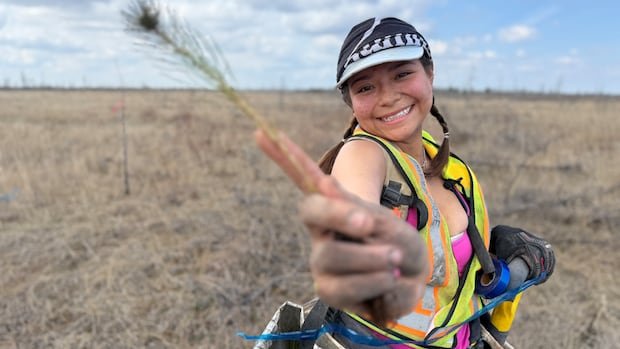

Marley Moose, a 22-year-old participant in a tree-planting crew in northern Manitoba, is dedicating her third summer to restoring forests decimated by wildfires. The task has become more demanding following the discontinuation of a federal initiative targeting the planting of two billion trees by 2030.
The region in Manitoba’s Interlake area, approximately 300 kilometers northwest of Winnipeg, suffered from a jack pine budworm infestation in 2016 and was in the process of recovering when wildfires struck the Devils Lake vicinity in 2021. Moose, actively engaging in reforestation efforts, expressed her emotional attachment to the land and the importance of preserving it for future generations.
The Canadian Tree Nursery Association (CTNA) highlights the challenge of trees being lost at a faster rate than they are replenished naturally or through human intervention. Factors such as deforestation for development, lumber, and paper, along with pest infestations like the mountain pine beetle, contribute to this imbalance.
The 2 Billion Trees Program, introduced by former Prime Minister Justin Trudeau and aimed at reforesting Canada, was terminated by the current administration to redirect funding towards defense and infrastructure. This decision jeopardizes tree-planting projects like the one facilitated by Nekoté LP, an Indigenous-owned corporation representing seven Swampy Cree First Nations.
With Canada experiencing consecutive severe fire seasons and managed forests emitting more carbon than they absorb, the necessity for sustainable reforestation initiatives is underscored. Despite the setback caused by the program’s cancellation, stakeholders in the forestry industry are collaborating to explore alternative solutions.
Farron Sharp, a project manager collaborating with Nekoté LP, emphasizes the significance of securing additional funding to achieve their ambitious goal of planting 20 million trees by 2030. She views tree-planting not only as an environmental necessity but also as a means to counterbalance the detrimental impacts of human activities on the planet.
While acknowledging the physical demands of tree-planting, Moose reflects on the gratification of contributing to the restoration of forests for the benefit of future generations. The collective effort to sustainably manage and replenish Canada’s forests remains crucial in mitigating the environmental challenges posed by climate change and wildfires.