

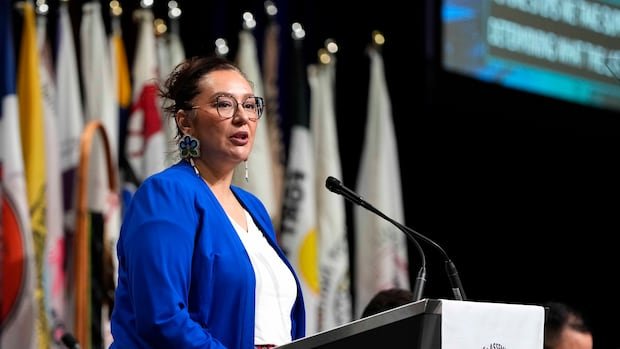

Indigenous Services Minister Mandy Gull-Masty stated that the Assembly of First Nations has conveyed a strong message to her government regarding the elimination of the second-generation cut-off in the Indian Act. However, she emphasized that any changes in this regard will only be considered after extensive consultations with leaders.
During a recent special assembly in Ottawa, First Nations chiefs voted in support of Senate amendments to a government bill aimed at widening eligibility under the Indian Act by removing the second-generation cut-off provision. This provision bars individuals from registering for status under the law if their parent and grandparent did not have status. The resolution, passed unanimously at the Assembly of First Nations meeting, also urged the government to provide increased funding to help communities accommodate new members.
The Assembly of First Nations serves as an advocacy group for 600 First Nations chiefs who gather biannually to address issues and pass resolutions guiding the executive committee on advocacy efforts. While all chiefs have the opportunity to attend these meetings, some choose not to participate. For instance, chiefs in Alberta lack regional representation on the AFN executive committee, although some may engage in AFN-led events.
Mi’kmaw Liberal MP Jaime Battiste stressed the importance of obtaining consent from First Nations, facilitated through the AFN, before making changes to the Indian Act. The AFN has previously advocated for the removal of the second-generation cut-off in multiple resolutions from past gatherings.
Minister Gull-Masty affirmed her commitment to consulting with chiefs and exploring alternative solutions following discussions on the second-generation cut-off during the recent AFN gathering. She highlighted the legal and constitutional obligation to engage with chiefs on such matters.
Bill S-2, introduced with Liberal government support in the Senate, aims to address gender disparities in the Indian Act and extend Indian status eligibility to approximately 6,000 individuals. Senators revised the bill to eliminate the second-generation cut-off, a provision introduced in a 1985 amendment to the Indian Act.
Some chiefs expressed concerns that the cut-off could jeopardize their communities’ federal recognition in the future, potentially eroding their distinct rights as a people. Chief Wilfred King of Gull Bay First Nation emphasized that individuals affected by the removal of the cut-off have strong community ties and are integral members of their respective communities.
Minister Gull-Masty stressed the need for consultations with First Nations before any legislative changes, criticizing the Senate’s alteration of the bill without House of Commons involvement. She empathized with chiefs’ apprehensions about legislation that governs First Nations lives.
Senator Paul Prosper, involved in amending the legislation in the Senate’s Indigenous Peoples committee, highlighted the widespread consensus among witnesses about repealing the second-generation cut-off. He noted that some policymakers view status eligibility changes primarily as a financial issue, as increased federal recognition would necessitate augmented per-capita funding for First Nations.
Overall, the AFN’s resolution on the second-generation cut-off signals a significant step towards addressing longstanding issues within the Indian Act, with a focus on inclusivity and community representation.