

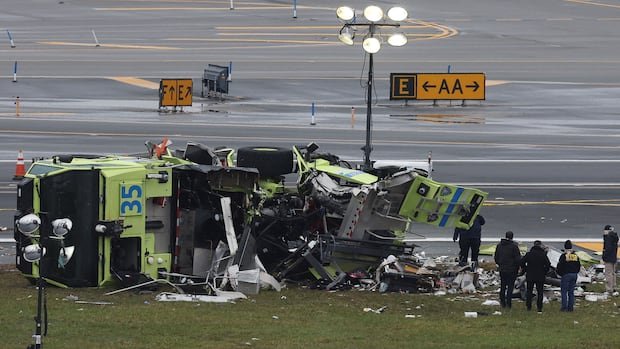

The National Transportation Safety Board has issued its initial findings regarding the fatal accident between an Air Canada aircraft and a fire truck at LaGuardia Airport in New York last month. The report points to communication breakdowns and the absence of transponders in the truck as factors contributing to the incident.
According to the report released on Thursday, the driver of the fire truck received radio instructions to halt but misunderstood that the message was directed at them. It was only when the turret operator heard a specific warning for “Truck 1” that they realized the communication was intended for their vehicle. By that time, the truck had already entered Runway 4 just as Air Canada Express Flight 8646 was landing.
The collision resulted in the tragic deaths of pilots Mackenzie Gunther and Antoine Forest, along with injuries to over 30 individuals, six of whom sustained severe harm.
The preliminary report by the NTSB details accounts from firefighters and personnel, offering a comprehensive overview of the events leading to the crash. The document did not include formal recommendations, as the final report is still pending.
Former NTSB air safety investigator Greg Feith highlighted the potential confusion caused by the initial command to “stop, stop, stop,” emphasizing the importance of clear and precise communication in such critical situations.
One contributing factor to the accident was the absence of transponders in the emergency vehicles at LaGuardia Airport, which are essential components of the ASDE-X surface surveillance system. This system is designed to monitor the movements of aircraft and vehicles in real-time to prevent runway collisions. However, none of the seven emergency vehicles involved were equipped with transponders, hindering the system’s ability to predict potential conflicts.
The NTSB’s report also noted that while the airport had red runway status lights activated during the incident to indicate runway occupancy, these lights were extinguished just moments before the collision occurred.
The FAA had previously recommended airports with ASDE-X systems to outfit emergency vehicles with transponders for enhanced safety measures. Additionally, the Transportation Safety Board of Canada has long emphasized the risks associated with runway incursions and the need for preventive measures.
Air traffic control transcripts revealed multiple attempts to warn the fire truck not to cross the runway, with repeated instructions to “stop” issued prior to the collision. Despite efforts to avert the tragedy, the controller expressed regret following the crash.
Regarding tower staffing, the NTSB found that the presence of two experienced controllers at the time was in line with standard practices. However, concerns over staffing levels have been raised within the air traffic control team due to workload pressures and staffing shortages. The NTSB report highlighted that the controllers on duty that night were at the beginning of their shifts.
The investigation into the incident continues, with a focus on staffing decisions and operational practices to prevent similar accidents in the future.