

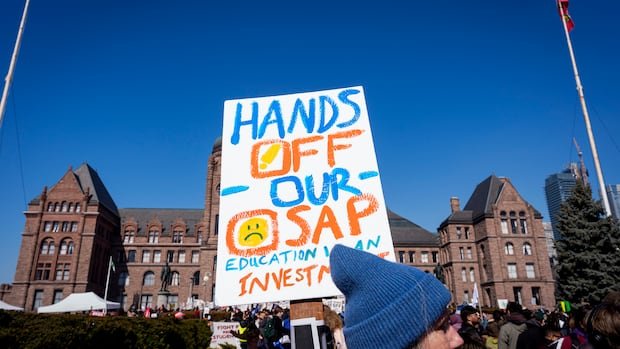

Ontario Premier Doug Ford’s government significantly reduced student assistance grants earlier this year, citing unsustainable costs. However, recent data reveals that almost all of the recent growth in spending was directed towards private career college students.
Information obtained through a freedom of information request by The Canadian Press indicates that between the academic years 2023-24 and 2024-25, the province allocated an additional $465 million towards Ontario Student Assistance Program grants, with 95% of this increase benefiting private career college students.
Opposition critics argue that the government’s decision to cut student aid, particularly the grant portion from 85% to 25%, was unnecessary and unfairly impacted university and publicly funded college students. Liberal critic for colleges and universities, Tyler Watt, emphasized that the government’s reasoning for the cuts does not align with the revealed expenditure data.
While both Ontario and federal financial aid portions for students have seen a general increase, the surge in funding for private career college students stands out. In the 2023-24 academic year, university students received around $370 million in Ontario Student Grants, which decreased to approximately $354 million the following year. Conversely, students at publicly funded colleges received $349 million in 2023-24 and $386 million in the subsequent year.
In contrast, career college students received $554 million in Ontario Student Grants in 2023-24, escalating to about $994 million the following year, surpassing the combined grant amounts for public college and university students. The growth in Canada Student Grants for these students was comparatively lower, rising from $201 million in 2023-24 to $338 million in the subsequent year.
Notably, the decision to exclude career college students from OSAP grants was part of broader financial aid reforms announced by Colleges and Universities Minister Nolan Quinn earlier this year, citing financial unsustainability. The proportion of non-repayable grants through OSAP was reduced from 85% to a maximum of 25%, prompting concerns from students and advocates regarding increased reliance on loans and heightened student debt burdens.
The College Student Alliance, representing students at publicly funded colleges, underscored the disparity in grant funding growth between private career colleges and publicly funded institutions, calling for transparency in OSAP policy changes and fair support distribution across the education system.
Government projections foresee grant spending reaching $2.7 billion by 2028-29, with an emphasis on reining in spending while ensuring accessibility for future students. Quinn defended the need for action to control spending, citing the unsustainable nature of the 2017 changes and emphasizing the importance of preserving financial aid for upcoming students.
The significant disparity in grant amounts between university and college students and career college students, as highlighted in a recent news outlet’s analysis, underscores the complexity and implications of financial aid policies on student access and affordability in Ontario.