

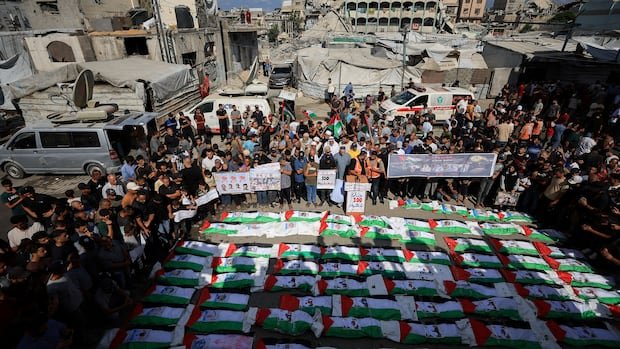

The retrieval of numerous bodies from the wreckage of buildings decimated by Israeli airstrikes in Gaza during the conflict that commenced nearly three years ago has sparked fresh apprehensions regarding potential war transgressions, as expressed by the United Nations human rights chief on Tuesday.
Volker Türk disclosed that the recovery efforts were uncovering the remains of entire families from locations demolished during Israeli offensives, emphasizing that a significant number of the deceased were women and children. He conveyed his dismay that families, who had been anxiously awaiting news of their missing loved ones for an extended period, were now confronted with the confirmation of their worst fears.
Türk highlighted the findings as reigniting concerns outlined in a 2024 UN report, which had identified potential breaches of international humanitarian law by Israeli strikes on residential structures and other civilian establishments in the initial stages of the conflict. In response, Israel’s Ambassador to the United Nations in New York, Danny Danon, criticized Türk for allegedly disregarding Hamas-related atrocities and prematurely ascribing blame to Israel before substantiated facts were established.
The Israeli Prime Minister’s Office and Foreign Ministry refrained from immediate comment requests. Israel has consistently refuted accusations of deliberately targeting civilians, asserting that its actions against Hamas combatants in Gaza were conducted in compliance with international legal standards.
The assault on Gaza instigated by Israel following a lethal incursion by Hamas into Israel in October 2023 has resulted in approximately 61 million tons of debris, expected to necessitate up to seven years for clearance, according to the United Nations. Although a U.S.-brokered ceasefire in October 2025 halted full-scale hostilities, both sides have accused each other of breaching the truce, with recurrent Israeli airstrikes persisting.
Palestinian Civil Defence figures indicate the recovery of over 630 bodies and human remnants from beneath ruined structures across Gaza since November 2025, with estimates suggesting that more than 8,000 individuals are still interred in the wreckage. Türk expressed apprehension that the retrieved remains could represent merely a fraction of the overall casualties, given the extensive destruction inflicted by Israeli bombing and subsequent clearance operations in Gaza.
Notably, Israeli constraints on essential resources like DNA kits and excavators have impeded the efficacy of recovery and identification tasks, as stated by Ajith Sunghay, head of the UN human rights office for the Occupied Palestinian Territory. Sunghay emphasized the severe challenges faced by Palestinian teams, sometimes compelled to undertake manual excavation due to restrictions imposed by Israeli authorities on relevant equipment.
The 2023 Hamas-led attacks resulted in 1,200 casualties in Israel and the abduction of 251 individuals based on Israeli records. Conversely, Gaza health authorities report that over 73,000 Palestinians have perished during Israel’s military campaign. The UN rights chief has advocated for international investigators to be granted unrestricted access throughout Gaza to facilitate evidence preservation, particularly in light of ongoing legal proceedings scrutinizing conduct during the conflict.
Israel’s refusal to permit the entry of heavy machinery essential for rubble removal, as underscored in Türk’s statement, has elicited concerns regarding the potential obliteration of crucial evidence. The UN expert on the Palestinian territories, Francesca Albanese, has stressed the importance of gathering evidence and identifying human remains before embarking on comprehensive clearance operations.
Recent reports from the Palestinian Civil Defence indicate the recovery of 96 bodies and human fragments from a single location in the Zeitoun area of Gaza City this month, comprising a significant number of children and women among the casualties.