


Austria Transforms Adolf Hitler’s Birthplace into Police Station to Deter Neo-Nazi Pilgrimages
A landmark transition unfolds as the building of Adolf Hitler’s birth in close proximity to the Austrian-German border is repurposed as a police station on Wednesday. The Austrian government’s initiative aims to thwart any potential glorification by neo-Nazis seeking pilgrimage to the site.
Following extensive deliberations regarding the sizable, traditional terraced residence located in Braunau am Inn, which previously housed a charity for the disabled under private ownership, Austria executed a compulsory acquisition in 2017. Subsequently, in 2019, the government disclosed plans to renovate the structure into a police station, with renovation commencing in 2023.
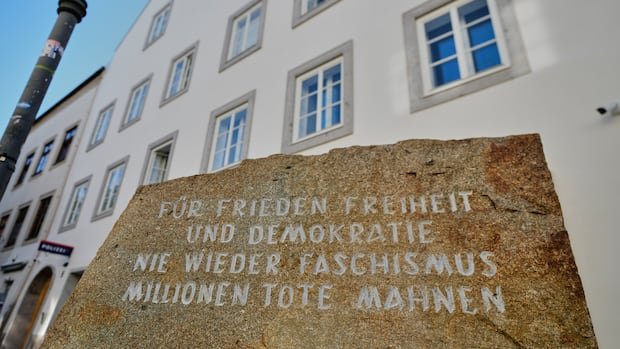
Even before the refurbishment, the sole indicator of its historical significance was a stone on the sidewalk from the Mauthausen concentration camp inscribed with “Never again fascism,” omitting any reference to Hitler. This memorial stone remains in place, with the addition of a discreet “Police” sign to the building’s white facade.
Stephan Mlczoch, the head of the Austrian Interior Ministry’s historical division, emphasized the intention to sever any links to Adolf Hitler, thereby eradicating any allure associated with the building. The structure, previously known as the “Fuehrer birth house,” served as an art museum during the Nazi era, where Hitler briefly resided in 1889 before his family relocated, as clarified by Mlczoch.
The building now attracts onlookers who frequently pause to capture images. Local authorities have reported a decline in incidents involving visitors, asserting that such occurrences are now sporadic.
Mayor Johannes Waidbacher expressed satisfaction with the community’s response to the project, affirming that the residents of Braunau have largely embraced the transformation. Waidbacher, a member of the commission that proposed utilizing the building for charitable or official functions, explained that establishing a charity there would have rendered it excessively accessible to the public.
While some dissent has surfaced, notably from the Mauthausen Committee, Austria’s primary association of Holocaust survivors, concerns have been raised regarding the appropriateness of housing a police station at the site. The committee advocates for heightened awareness of Hitler’s atrocities and emphasizes the significance of commemoration.
Robert Eiter, a representative of the Mauthausen Committee and the Network Against Racism and Right-Wing Extremism, voiced skepticism regarding the cessation of neo-Nazi pilgrimages to Braunau, underscoring the enduring memory of Hitler’s heinous crimes and the imperative of remembrance.
Austria, formerly asserting victimhood in the wake of National Socialism, now acknowledges the complicity of Austrians as perpetrators, albeit with limited elaboration. Eiter emphasized the enduring global recognition of Hitler’s birthplace as the epicenter of unfathomable atrocities, predicting that revisions in historical narratives will not deter neo-Nazi visitations to Braunau.