

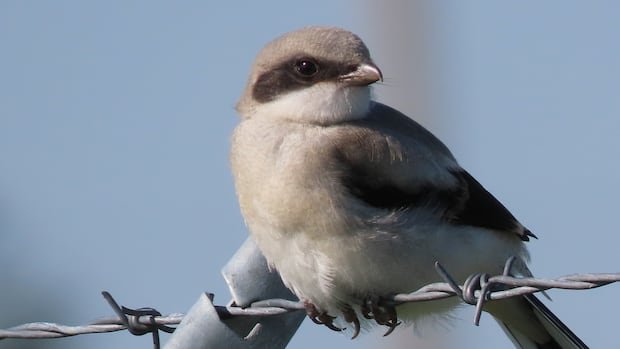

Graceful and chubby in appearance, the songbirds exhibit striking white patches on their grey and black wings when in flight. However, during feeding time, these seemingly gentle birds transform into ruthless hunters. They capture various prey such as insects, rodents, and amphibians, and then skewer them on thorns or barbed wire before consuming them.
These birds are loggerhead shrikes, a species at risk commonly referred to as “butcher birds.” While their primary breeding area is in Saskatchewan’s Prairies, conservationists warn that their habitats are gradually vanishing.
Kerry Hjertaas, a 42-year-old birder from Saskatoon, witnessed shrikes in action near his workplace this summer.
On one occasion, as Hjertaas was entering his vehicle, a shrike landed on the barbed-wire fence by the parking lot and impaled its prey on the wire. Another shrike joined in to feed on the prey as well.
“They both started tearing into it, and it vanished quickly,” he described. “I had only read about this before, so witnessing it firsthand was incredibly fascinating.”
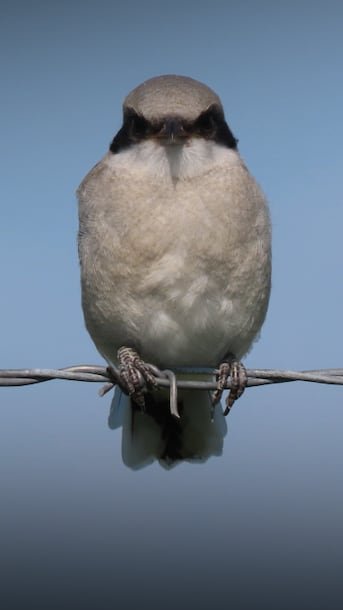
Loggerhead shrikes are a threatened species colloquially known as a “butcher bird.” Their main breeding ground on the Prairies is in Saskatchewan, but wildlife advocates say their habitats are slowly disappearing.
According to Emily Putz, the habitat stewardship co-ordinator of Nature Saskatchewan’s shrubs for shrikes program, shrikes adopt this hunting technique because, as songbirds, they lack talons on their delicate feet.
She highlighted that shrikes are the only birds in Saskatchewan to hunt in this manner.
“They are an exceptionally unique bird with distinct behaviors,” Putz remarked. “Observing them in action is truly remarkable.”

A species at risk
Approximately 40,000 shrikes remain in Saskatchewan, as per Putz. These birds are classified as a threatened species, a status one level below being endangered.
Putz emphasized that habitat loss poses a significant threat to shrikes. These birds depend on native prairie areas for nesting and hunting, yet Saskatchewan retains only about 13 percent of its original prairie lands. Consequently, shrikes have adapted to reside in shelterbelts, which are shrubs encircling fields.