

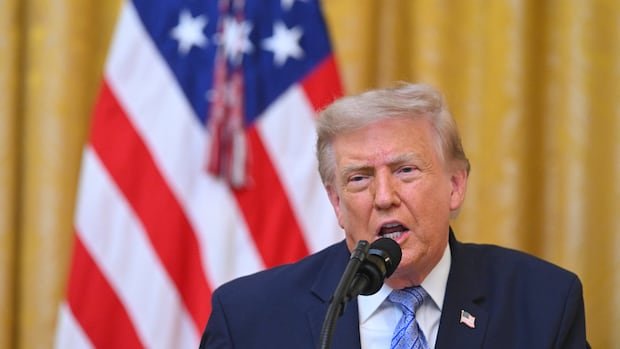

U.S. President Donald Trump made public classified intelligence on Thursday alleging Chinese interference in U.S. elections, reigniting his ongoing criticisms of election integrity despite a U.S. intelligence report that found no proof of Beijing tampering with the 2020 election, which he lost.
In his 25-minute televised speech, Trump emphasized his push to prioritize election security as a key issue leading up to the midterm elections in November. He urged Republican lawmakers to pass legislation mandating new voter identification and citizenship requirements, even though voter fraud in U.S. elections has been consistently reported as rare. However, the proposed bill has faced resistance from Democrats, causing a deadlock in the Senate.
While Trump claimed the declassified information would expose vulnerabilities in the U.S. election system, many of the documents seemed to indicate the opposite or were unrelated to election infrastructure.
Despite the challenging political landscape for Trump and the Republicans, with low approval ratings due to the Iran conflict and rising energy costs, the President highlighted his domestic achievements before addressing election security concerns.
Trump alleged that China had obtained 220 million U.S. voter records illegally, including personal details used for voter registration. He also accused the U.S. intelligence community of withholding information about China’s activities.
Contrary to Trump’s claims, a 2021 U.S. intelligence assessment led by John Ratcliffe, then Director of National Intelligence under Trump, found no evidence of foreign interference in the 2020 election. The assessment revealed China’s long-standing efforts to gather information on U.S. voters for predictive purposes.
Prior to Trump’s speech, White House officials expressed concerns that revealing the Chinese information could be misleading. Trump’s rhetoric against China risked straining diplomatic relations, as he aimed to discuss trade relations with Chinese President Xi Jinping in September.
Trump’s persistent allegations of election fraud and manipulation, including doubts about mail-in voting and voting machines, have been widely discredited by courts and recounts following the 2020 election.
During his speech, Trump referenced documents highlighting election vulnerabilities, although some were unrelated to U.S. election infrastructure, such as a CIA report on Venezuela’s elections.
Democratic Senator Mark Warner dismissed Trump’s claims about China as baseless, reiterating that U.S. intelligence agencies confirmed no attempts by China to alter the 2020 election outcome.
While Trump painted U.S. elections as susceptible to manipulation, he failed to provide evidence of actual voter fraud incidents in 2020. Some major television networks chose not to broadcast his address on their primary platforms.
Since his return to office, Trump has sought to expand federal oversight over elections, advocating for stricter voting requirements through legislation like the SAVE America Act, which has faced opposition from Democrats and voting rights advocates.
As the midterm elections approach, Republicans and Democrats are gearing up for a contentious battle over control of Congress, with Trump’s focus on election integrity diverging from other pressing issues like economic concerns and high living costs.