

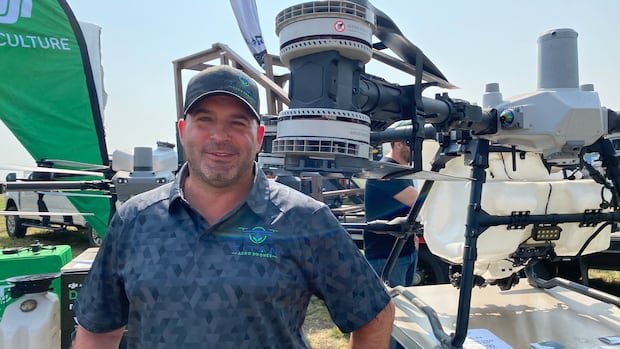

Last year, sales representative Ryan Crumly had predicted that farmers would quickly adopt drone technology once it was legally permitted to use them for spraying insecticides and fungicides on crops. It seems his prediction was accurate. By the end of June, Health Canada removed its restrictions on using drones to spray approved pesticides, leading to a surge in demand among farmers for this technology, according to Crumly from Titan Aero Drones, who mentioned that they quickly sold out close to 80 drones in just a few days.
Both farmers and drone dealers have embraced this policy change, citing the effectiveness of drones over traditional ground sprayers and planes. The adoption of pesticide-spraying drones is anticipated to be substantial, with many farmers expressing interest in purchasing one in the near future.
Pesticide-spraying drones are being hailed as an innovative technology with various advantages. Unlike planes and helicopters that are limited to daytime operations and restricted by obstacles like trees and power lines, drones offer more flexibility. Some farmers have shown particular interest in drones this year due to challenges like flooding that hinder the use of ground sprayers.
These drones are user-friendly, allowing farmers to plan the spraying route and operations, with the drone capable of autonomous flight for the most part. The operational ease has been likened to being a mere overseer responsible for battery changes and refilling the tank.
Greg Hill, a farm and ranch owner from southeast Saskatchewan, envisions drones making a significant impact in agriculture. He highlighted the issue of ground sprayers potentially damaging significant crop acreage compared to drones, which offer a more precise and efficient alternative.
Although the initial cost of spray drones can reach tens of thousands of dollars, they are still more cost-effective than high-priced ground sprayers. The operational expenses are significantly lower, with drone operation costing around 83 cents per acre compared to $10.50 per acre for ground sprayers.
Despite the benefits, some farmers are wary of the initial investment required for purchasing drones. However, there is a growing interest in adopting this technology, acknowledging its potential and anticipating further advancements in drone capabilities in the near future.