

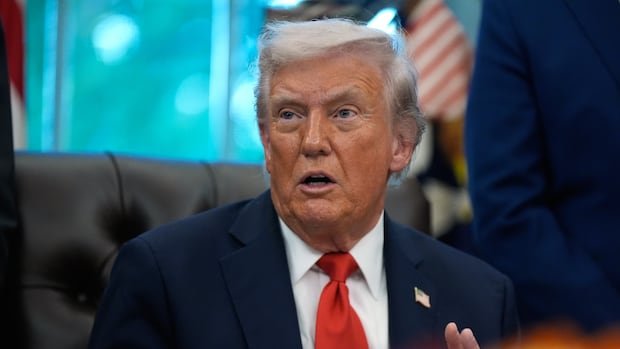

President Donald Trump asserted on Tuesday that he is potentially owed a substantial amount of money in response to reports indicating his pursuit of $230 million in damages connected to two investigations into his actions. The New York Times disclosed that Trump had initiated administrative claims before his re-election last November, pertaining to the FBI’s 2022 search of his Mar-a-Lago estate for classified materials and a prior inquiry into potential links between Russia and his 2016 election campaign.
The current status of these claims and any discussions within the Justice Department regarding them are not immediately evident. A spokesperson from the Justice Department informed The Associated Press that all officials within the department adhere to the counsel of career ethics professionals in any situation.
In the Oval Office on Tuesday, Trump expressed that any determinations on the matter would need his approval. Bennett Gershman, an ethics professor at Pace University, characterized the situation as a “travesty,” emphasizing the ethical conflict as straightforward and essential, not necessitating a legal expert’s explanation.
This development emerges in the midst of Democratic contentions that the Justice Department is aiding Trump in targeting political adversaries, with three of his critics recently facing indictments.
One of the claims, documented in 2024 and examined by The Associated Press, requests compensatory and punitive damages related to the probe of his Mar-a-Lago property in August 2022. Trump’s attorney filing the claim alleged that the case constituted a “malicious prosecution” orchestrated by the Joe Biden administration to impede Trump’s efforts to regain the presidency, resulting in considerable defense expenditures for Trump.
On the other hand, prosecutors contended that Trump, acting as a private citizen, resisted multiple requests to return all documents and sought to obstruct the retrieval of certain documents post a subpoena issuance. Trump was confronted with 37 felony charges, including alleged violations of the Espionage Act, involving 18 top-secret, 54 secret, and 31 confidential documents.
The Trump-Russia investigation, which has continually provoked the president, was the subject of the other complaint seeking damages. Special counsel Robert Mueller affirmed in 2019 that indicting Trump was never under consideration, yet highlighted that the investigation could not absolve him of allegations of obstructing the inquiry.
Moreover, Trump hinted at potential compensation linked to the disputed 2020 election. Despite recounts and audits affirming Biden’s victory in key states, multiple legal challenges presented by Trump were dismissed by judges, including those he appointed. Former Attorney General William Barr stated post-election that there was no widespread fraud altering the election outcome, a sentiment he reiterated before a congressional committee.
While a significant number of Trump supporters rallied at the U.S. Capitol on January 6, 2021, attempting to thwart Biden’s certification, the indictment against Trump for his alleged role in instigating the riot was another case that dissipated with his re-election last year. Trump subsequently pardoned numerous individuals implicated in the Capitol attack.
Trump’s interest in compensation was publicly signaled during a recent White House appearance with law enforcement officials. Democratic Sen. Adam Schiff criticized Trump’s desire for significant payouts related to the insurrection, insinuating that the president is seeking remuneration for inciting the event.
If the Justice Department sanctions compensation for the investigations, Trump proposed donating the funds to charity or utilizing them for White House renovations amid the controversial demolition project in the East Wing, aligning with his plans to revamp the White House’s ballroom.