

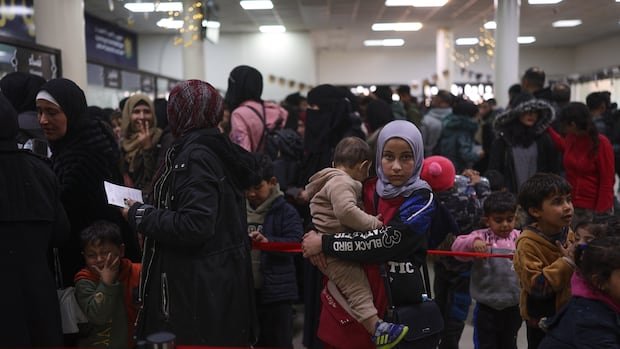

More than 100,000 Syrian refugees have returned to Syria from Lebanon this month, seeking refuge from escalating violence and conflict in a country still in the process of recovery after enduring over a decade of civil war.
The Jdeidet Yabous border crossing, serving as the primary gateway between Lebanon and Syria, witnessed a constant stream of buses and cars carrying families escaping intense Israeli bombardment and escalating confrontations in Lebanon. Some vehicles were loaded with mattresses and piled high with belongings as families hurriedly sought safety.
Despite the urgency to cross the border and ensure their families’ safety, many Syrian refugees declined to disclose their full identities to CBC News due to time constraints and fears of potential repercussions from Lebanese authorities upon their return.
Fatimah, a Syrian woman traveling with her children, recounted her family’s two-year stay in southern Lebanon after fleeing the Syrian civil war. She tearfully described an airstrike that tragically claimed the lives of her sister-in-law’s son and his wife, who were newlyweds of only five months, lamenting the injustice of their untimely deaths.
Leaving Lebanon, which has become embroiled in a new conflict following Hezbollah’s attacks on Israel, has plunged many Syrians back into the throes of warfare. Fatimah expressed her anguish at facing yet another war and the challenges of safeguarding her family amidst escalating hostilities.
As temperatures dropped and conditions worsened during their journey, Fatimah held her freezing children close to provide comfort and warmth. The arduous 120 to 160-kilometer trip from southern Lebanon to the border has become even more challenging, with some forced to abandon their possessions, like Fatimah who left with only the clothes on her back.
Upon arrival at the border, exhausted refugees fasting for Ramadan were met with assistance from Syrian Civil Defence crews and civil organizations, offering aid, sustenance, and medical support. While some individuals plan to return to their hometowns or stay temporarily with relatives, others aim to secure employment to afford housing. Fatimah’s husband, who stayed behind in Lebanon to assist with burials, intends to join his family in Syria later.
The ongoing conflict has prompted a mass exodus of people from Lebanon to Syria, with over 125,000 individuals crossing the border since early March, according to the International Organization for Migration (IOM). The influx highlights the widespread impact of Israeli strikes on Lebanon, affecting both Syrians and Lebanese citizens.
Syria, still grappling with the aftermath of years of war, has seen a significant number of refugees returning home. UNHCR estimates that around 1.3 million Syrian refugees have repatriated, with the current conflict in the region further driving this trend.
Amid the challenges of rebuilding their war-torn country, Syrian returnees are assisted by government initiatives and international aid agencies to facilitate a safe and voluntary return process. Raed al-Saleh, Syria’s minister of emergency and disaster management, emphasized the collective effort to support returning families and rebuild the nation, underscoring the returnees’ journey as a reunification with their homeland rather than a humanitarian crisis.