

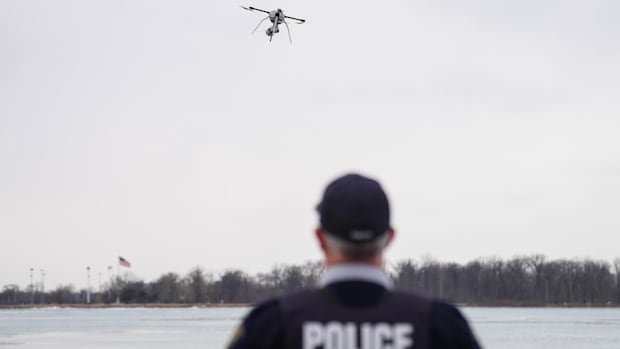

The Royal Canadian Mounted Police has decided to restrict the use of its 973 drones manufactured in China to non-sensitive operations due to concerns over potential security risks associated with their country of origin. These Chinese drones make up the majority, around 80%, of the RCMP’s fleet of 1,230 remotely piloted aircraft systems (RPAS) used for various purposes, including monitoring the Canada-U.S. border and assisting in police operations.
In response to the national security committee of the Senate, the RCMP stated that replacing these Chinese drones would incur a cost exceeding $30 million, averaging about $35,000 per device. The higher cost of alternative non-Chinese drones, which are nearly twice as expensive, was cited as a significant factor. Experts have highlighted the potential security vulnerabilities associated with the communication and data-transmission systems of these drones.
To address these concerns, the RCMP has taken measures to limit the in-flight transmission of data by the Chinese drones and has reserved them for non-sensitive tasks such as assisting in missing persons cases, car theft investigations, and community policing activities. The police force has explicitly stated that Chinese drones are not utilized for emergency response operations, protection of VIPs, border integrity missions, or joint investigations with U.S. authorities.
For more critical and sensitive operations, the RCMP relies on drones sourced from France, the United States, and Belgium. The country of origin for about 2% of the drones in use is not disclosed by the RCMP, described as custom-made or part of research and development projects. Despite the security concerns, the RCMP pointed out that Chinese drones were purchased before the restrictions were implemented in 2023, emphasizing their cost-effectiveness and efficiency compared to traditional aircraft.
Experts have advised caution regarding the use of Chinese drones, as the origin of numerous parts, software, and data-storage systems cannot be verified. They recommend centralized procurement processes and security testing for all drone acquisitions for security purposes in the future, suggesting a preference for Canadian manufacturers and supply chains to mitigate potential risks.