

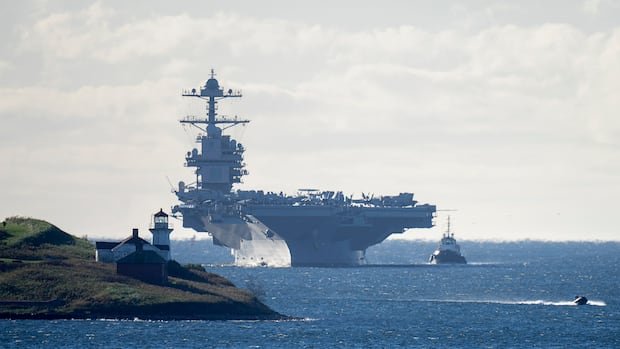

The Pentagon announced on Friday that the U.S. military will be sending an aircraft carrier to the waters near South America, as part of increased military presence in the region. Defence Secretary Pete Hegseth has directed the USS Gerald R. Ford and its accompanying strike group to deploy to the U.S. Southern Command area to enhance U.S. capabilities in identifying, monitoring, and disrupting illicit activities that threaten the safety and prosperity of the United States.
Currently, the USS Ford, along with its five destroyers, is stationed in the Mediterranean Sea. One destroyer is positioned in the Arabian Sea, another in the Red Sea, and as of the latest update, the aircraft carrier is docked in Croatia on the Adriatic Sea. The deployment of the aircraft carrier and its strike group will significantly bolster resources in a region already experiencing a substantial U.S. military buildup in the Caribbean Sea and off the coast of Venezuela.
The recent surge in military actions, including the deployment of the USS Ford strike group, has sparked speculations about the extent to which the Trump administration may escalate operations in its efforts against drug trafficking. There are concerns about potential actions targeting Venezuelan President Nicolas Maduro, who is facing allegations of narcoterrorism in the U.S.
With over 6,000 sailors and Marines on eight warships already in the region, the arrival of the entire USS Ford strike group could bring an additional nearly 4,500 sailors and nine squadrons of aircraft. The situation is further complicated by Tropical Storm Melissa, lingering in the central Caribbean and posing a potential threat of intensifying into a hurricane.
Prior to the official announcement, Defence Secretary Hegseth disclosed that the military had carried out the 10th strike on a suspected drug-running vessel, resulting in six casualties. The operation targeted a vessel associated with the Tren de Aragua gang, marking the second time the gang has been linked to U.S. military actions.
The frequency of strikes has escalated from once every few weeks to three strikes in a single week, with recent operations expanding to the eastern Pacific Ocean to combat cocaine smuggling routes. In a related development, the Trump administration imposed sanctions on Colombian President Gustavo Petro and his associates, citing their alleged involvement in the global drug trade.
Despite the administration’s focus on combating drug trafficking, Venezuelan President Maduro views the U.S. military activities as attempts to destabilize his leadership. Maduro commended the country’s security forces and civilian militia for conducting defence exercises along Venezuela’s coastline in preparation for potential U.S. threats.
According to Elizabeth Dickinson of the International Crisis Group, the increased U.S. military presence in the region is seen as a strategic move to assert influence and align regional countries with U.S. interests, with drug-related concerns serving as a pretext for broader geopolitical objectives.