

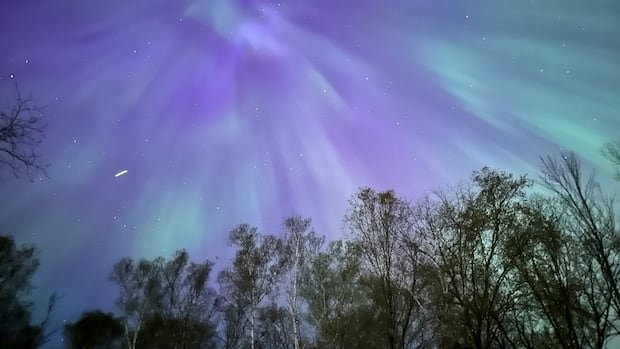

Southern Canadians have recently had the opportunity to witness vibrant neon-hued night skies, filled with shades of purple, pink, and green due to increased solar activity in the past two years. However, this magnificent display of the northern lights is expected to fade as the sun transitions into a calmer phase of its 11-year cycle.
The prime locations to observe the dancing lights will continue to be in the Northwest Territories, Yukon, and Nunavut, where the auroral oval, a luminous halo encircling the magnetic poles, is most prominently visible. According to Ethen Sun, a Ph.D. candidate at the University of Toronto’s David A. Dunlap astronomy and astrophysics department, sightings of auroras in southern regions of Canada, such as parts of Ontario, British Columbia, Saskatchewan, and Manitoba, will become less frequent with the decline in solar activity.
The sun progresses through periods of intense solar maximum and low-activity solar minimum. Sun mentioned that the current phase is approximately a year and a half past the maximum, with solar activity diminishing as it approaches the minimum in 2031. During the solar maximum, there are notable occurrences like coronal mass ejections, flares, sunspot increases, and geomagnetic storms, leading to vivid northern lights displays.
While auroras can be observed almost nightly above the 60th parallel, regardless of solar activity, the best time to witness these natural phenomena is between September and April, particularly around the spring and autumn equinoxes. As solar activity decreases, the extraordinary colors and movements seen over the past couple of years may diminish, signaling a gradual decline in peak viewing opportunities.
Tourism reports from Yukon highlighted plans to leverage the “solar max” period between 2023 and 2025 to attract tourists, with the northern lights being a significant draw for visitors from the United Kingdom, Germany, Switzerland, and Australia. The territory’s tourism sector reaped substantial economic benefits, amounting to $484 million in 2025.
In Yukon, Aaron Ratko, a board member of the Wilderness Tourism Association, noted that tourists visit during various seasons, with some experiencing the extreme cold of winter at around -40 degrees Celsius to witness the aurora. Repeat visitors often return during fall, enjoying milder temperatures and diverse day tours apart from the aurora sightings.
Alex Stubbing, CEO of Travel Nunavut, emphasized that Nunavut’s tourism focus lies more on showcasing Inuit culture, heritage, landscapes, and wildlife rather than solely on the northern lights. Nonetheless, as the solar maximum phase subsides and the three northern territories emerge as premier aurora destinations, Nunavut may consider promoting itself as a key location for northern lights enthusiasts.
In the Northwest Territories, the northern lights are a common nightly spectacle, with Yellowknife boasting up to 240 nights of aurora sightings per year. The region attracts a significant number of tourists due to the northern lights, contributing to the local economy and supporting businesses such as hotels, restaurants, and tour operators.
Marie-Soleil Lacoursière, operations manager at Aurora Village in Yellowknife, highlighted the economic significance of the northern lights for the territories, driving revenue and boosting various businesses. Despite the evolving solar cycle, businesses like Aurora Village continue to thrive, attracting visitors with awe-inspiring aurora experiences that surpass expectations.