

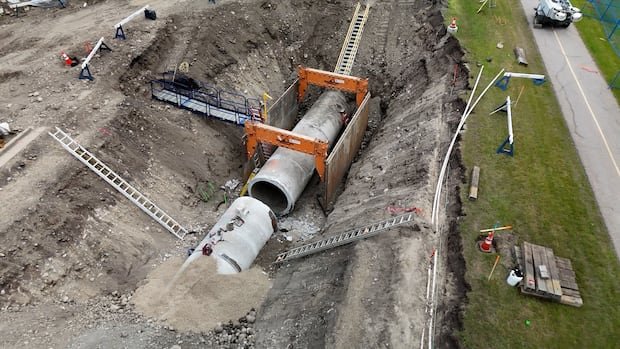

After a recent snowfall, Calgary has resumed the use of road salt, following concerns raised in a report last year linking the city’s reliance on sodium chloride to the rupture of the largest water feeder. The incident in June 2024 led to a local state of emergency and water restrictions due to the Bearspaw south feeder main break. An investigation into the causes revealed issues such as microcracking in the protective mortar around the pipe, snapped wires from corrosion cracking, and high chloride levels in the soil, likely stemming from road de-icing activities using sodium chloride.
Chris Hewitt, the city’s manager of mobility maintenance, emphasized that sodium chloride remains the preferred product for winter road maintenance in Calgary due to its effectiveness and standard use across North America. The city uses approximately 40,000 to 50,000 tonnes of road salt annually, with a noticeable increase in chloride concentrations in soil sampling data between 2014 and 2024.
While the city currently relies on sodium chloride and calcium chloride for road salt, it has also tested alternative options such as “pickle” (sand with a small salt amount) and beet brine (beet extract and salt brine). Beet brine, with lower sodium chloride levels, has been used for downtown winter maintenance following positive results from a pilot project, although it is considered more costly. In comparison, Lincoln, Neb., has fully adopted a beet brine solution for winter road maintenance, citing reduced infrastructure and environmental damage.
Calgary authorities are investigating the impact of de-icing materials on buried infrastructure, with plans to share findings on corrosion mitigation strategies in the coming months. City councillors, including Jennifer Wyness, Andre Chabot, and Dan McLean, are considering alternative road salt options for winter maintenance, acknowledging the need for effective solutions that minimize damage and costs. The ongoing review of the Bearspaw south feeder main break estimates repair costs at $40 million, with additional independent assessments being conducted.
The city’s proactive approach to exploring road salt alternatives and addressing infrastructure concerns reflects a commitment to sustainable and cost-effective solutions for winter road maintenance.