

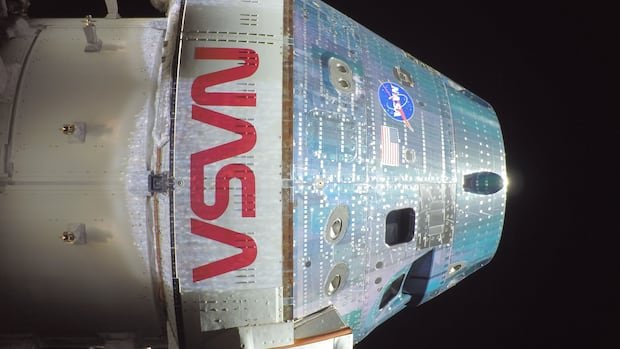

The Artemis II mission is anticipated to achieve a groundbreaking lunar flyby today. According to the Canadian Space Agency, astronaut Jeremy Hansen and his three American counterparts are poised to break the record for the farthest distance traveled in space, surpassing the milestone set by Apollo 13 in 1970. NASA projects that during today’s flyby with the Orion spacecraft, the maximum distance from Earth will exceed 406,000 kilometers, outstripping Apollo 13’s record of 400,171 kilometers.
As the Orion spacecraft passes behind the moon, a communication blackout of approximately 40 minutes will occur due to radio signals being blocked by the lunar surface. Subsequently, the spacecraft will approach as close as about 6,500 kilometers to the moon’s surface. Hansen has described that from this proximity, the moon will appear akin to a basketball held at arm’s length.
During a period of slightly over five hours, the crew is expected to alternate in observing and capturing images of geological features on the moon, such as impact craters and ancient lava flows. Commander Reid Wiseman, pilot Victor Glover, Christina Koch, and Jeremy Hansen from Canada are on course to skim as close as 6,550 kilometers to the moon in their Orion capsule before heading back towards Earth. The journey back will take four days, culminating in a splashdown near San Diego, concluding their test flight nine days after its launch from Florida.
Preparations for this significant event included years of studying lunar geography by Wiseman and his crew, who also experienced solar eclipses in recent weeks. By launching last Wednesday, they positioned themselves to witness a total solar eclipse from behind the moon. The crew will conduct lunar observations with real-time data analysis, aided by a team of scientists and their geological training in Labrador, Iceland, and in classrooms to provide valuable data for future moon exploration.
The lunar flyby offers a unique opportunity to view the moon’s far side, including landmarks such as the Orientale basin, a 3.8-billion-year-old crater formed by a celestial impact. Other planned sights include the Apollo 12 and 14 landing sites, as well as glimpses of Mercury, Venus, Mars, Saturn, and Earth. NASA geologist Kelsey Young anticipates the capture of thousands of images during this expedition.
Following the flyby, Orion will depart the moon’s sphere of influence on Tuesday as it heads back to Earth. Unlike Apollo 13, where a technical issue prevented a moon landing, Artemis II’s trajectory involves a figure-eight path that does not involve orbiting or landing on the moon.