

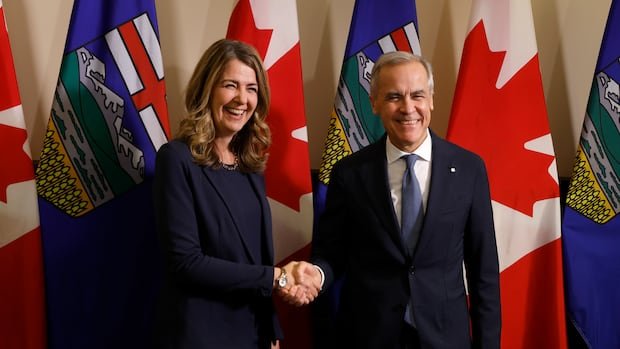

The federal and Alberta governments have reached an agreement on climate and energy that could lead to the commencement of construction on an oil pipeline to the West Coast by September 2027. Prime Minister Mark Carney and Alberta Premier Danielle Smith unveiled the agreement in Calgary, building on a previous memorandum of understanding signed in November. The deal includes a plan to incrementally raise Alberta’s industrial carbon price, though at a slower rate than initially anticipated.
Under the agreement, Alberta is expected to present a proposal for a new oil pipeline to the major projects office by July 1, with the federal government slated to designate it as a project of national interest by October 1. The Alberta government anticipates that design and construction could potentially begin as early as September 1, 2027. Both governments emphasized the importance of consulting with Indigenous communities and engaging with British Columbia regarding the pipeline application.
During a signing ceremony in Calgary, Carney and Smith delivered remarks without taking questions, later holding separate news conferences to address reporters’ inquiries. Smith expressed optimism about the agreement, highlighting its significance for Alberta and Canada’s energy leadership goals. Carney emphasized the importance of building trust and collaboration within Canada’s federal system.
While no private sector proponent or route for the pipeline has been identified yet, the Alberta government will act as the project’s proponent in submitting the proposal. Officials project that the pipeline could potentially transport oil by 2033 or 2034. The agreement also reaffirms a commitment to the Pathways project, a carbon capture and storage initiative, emphasizing its interdependence with the pipeline projects.
The agreement outlines a phased increase in Alberta’s industrial carbon price, aiming for $130 per tonne by 2040, with a minimum floor price for credits starting in 2030. This adjustment appears to set Alberta’s target below the national carbon price, which was slated to reach $170 per tonne by 2030. Critics have raised concerns about the agreement’s potential impact on clean energy investment and climate change targets.
Smith defended the agreement, highlighting industry cost savings and characterizing it as a significant concession. Carney assured that the agreement aligns with net-zero emissions targets by 2050, mitigating potential emissions increases from the pipeline. Discussions with other provinces are underway to ensure consistency in carbon pricing across the federal backstop.
B.C. Premier David Eby expressed reservations about rewarding Alberta’s behavior amid discussions of potential secession, while Smith emphasized support for a united Canada and improved intergovernmental cooperation. Opposition parties have criticized the agreement, with Conservative Leader Pierre Poilievre advocating for faster pipeline construction without a carbon tax, and NDP Leader Avi Lewis condemning the deal as a surrender to the oil and gas industry.
The agreement also addresses clean electricity regulations, with provisions for potential negotiations on equivalency agreements or repeal pending legal outcomes. Carney recently announced a national strategy to double Canada’s electrical grid capacity by 2050, incorporating a broader role for natural gas power.