

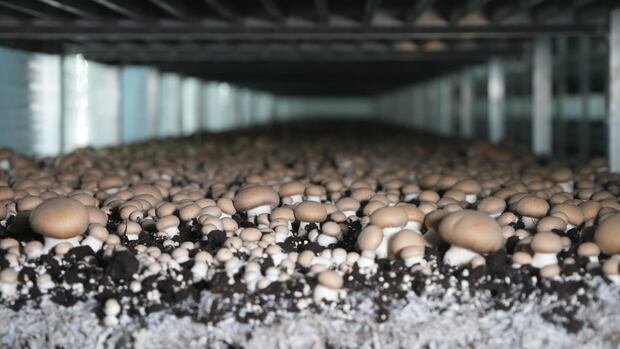

The United States is preparing to impose countervailing duties on fresh mushrooms cultivated in Canada, triggering concerns among Canadian growers about potential wider repercussions for the agricultural sector in both countries. According to a fact sheet from the U.S. Commerce Department disclosed to CBC by the Canadian Mushroom Growers’ Association, after an investigation, the U.S. government will apply tariffs ranging from 1.6 to five percent on Canadian fresh mushrooms.
Countervailing duties are imposed on imports deemed to receive unfair subsidies. Previous U.S. investigations have led to duties on Canadian softwood lumber for many years. The investigation by the Commerce Department began in January following a petition from U.S. growers who alleged that certain tax exemptions in Canada unfairly subsidize Canadian mushrooms.
Ryan Koeslag, the executive vice-president of the Canadian Mushroom Growers’ Association, challenged the rationale behind countervailing duties based on a tax exemption, calling it unprecedented as agricultural products in both countries benefit from similar exemptions. Koeslag emphasized that many countries worldwide, including the United States, offer agricultural tax exemptions.
He cautioned that using tax exemptions to justify countervailing duties could expose Canadian and American agricultural products to additional tariffs, potentially leading to a broader impact on both countries’ agriculture sectors. This move could prompt other countries to retaliate against the U.S. with similar measures, creating a risky situation in the long term.
The Agriculture Minister’s office in Canada was approached by CBC News for a statement on Thursday regarding the mushroom duties. The office redirected inquiries to Canada-U.S. Trade Minister Dominic LeBlanc’s office. LeBlanc’s office, in turn, referred the matter to Global Affairs Canada, which responded to CBC News on Friday, stating they are examining the Commerce Department’s preliminary determination and actively participating in the investigation to address systemic issues and safeguard the interests of the Canadian mushroom industry.
Additionally, the U.S. initiated a separate investigation that may lead to additional anti-dumping tariffs on mushrooms later this year. Fresh mushroom exports to the U.S. saw a 13 percent increase from 2023 to 2024 but experienced a nearly four percent decline last year, based on Industry Canada data.
The imposition of countervailing duties coincides with the ongoing review of the trilateral trade agreement among Canada, the U.S., and Mexico, which came into effect in 2020. The three nations have until July 1 to determine whether to extend the Canada-U.S.-Mexico Agreement (CUSMA) beyond 2036. Negotiators on both sides of the Canada-U.S. border have indicated that not all issues will be resolved by the beginning of July.