

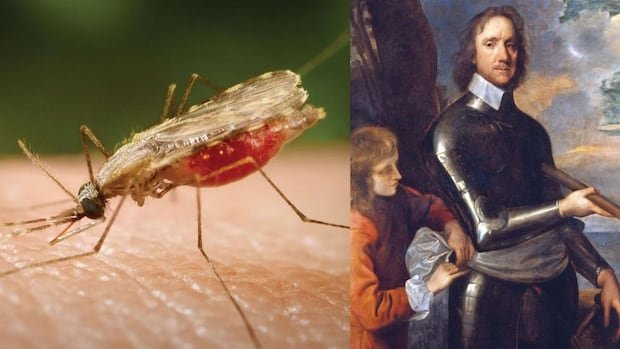

In Cork, Ireland, a city councillor is advocating for the installation of a public statue depicting a mosquito. This particular mosquito is believed by some in Cork to have bitten Oliver Cromwell, the English invader, leading to his demise from “Cork fever,” an old term for malaria. The councillor, Oliver Moran from the Green Party, envisions this unique statue to be the smallest in the world, to be placed on an empty plinth outside Cork City Hall.
Acknowledging the divisive nature of Cromwell’s historical legacy, Moran highlights the contrasting views of the figure on either side of the Irish Sea. In Ireland, Cromwell is remembered for his brutal military campaigns during the 17th century, causing significant loss of life in a bid to assert English dominance over the country.
Given Cromwell’s controversial reputation, Moran sees the proposed mosquito statue as a tongue-in-cheek way to commemorate the insect believed to have played a role in Cromwell’s demise. The councillor was inspired by a social media conversation where the idea was floated, leading him to champion the concept of a public monument to the mosquito.
In terms of Cromwell’s legacy, Moran points out the stark contrast in how the figure is perceived in Ireland compared to England. While Cromwell is celebrated in some circles for his role in promoting democracy and parliamentary authority, in Ireland, his campaigns resulted in widespread death and suffering, shaping a narrative colored by atrocities and military aggression.
As for the design of the statue, Moran is in the early stages of planning and is encouraged by the positive reception to the idea. Various locations are being considered, including the empty plinth outside Cork City Hall and a historic stone fort in the city center with connections to the Cromwellian era.
Addressing concerns about the historical accuracy of linking Cromwell’s death to a specific mosquito, Moran emphasizes the symbolic value of the story rather than strict factual accuracy. He sees the narrative as a reflection on the downfall of tyrants and the potential for small entities to bring down the mighty, conveying a broader message through public art in Cork.
Moran’s proposal aims to explore the intersection between public art and the natural environment of Cork, a city with a rich history intertwined with its marshland origins.