

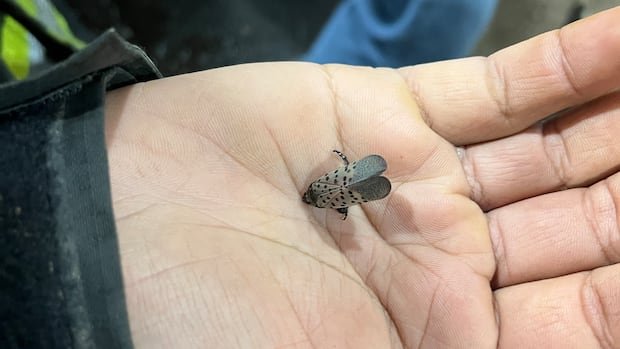

A recent finding of spotted lanternflies in St. Catharines, Ontario, has raised concerns about the invasive insect making its way into Canada from the United States. While there are currently no established populations of spotted lanternflies in Canada, experts warn that the insect poses a significant threat to vineyards, fruit trees, and hardwoods due to its feeding habits that can lead to the death of grapevines.
The discovery was made by Aidan Dagg, a resident of Ontario, who stumbled upon a dead spotted lanternfly and documented it on iNaturalist, a platform for sharing and identifying plants and animals. Dagg, who works as a nursery inspector, had been monitoring for the insect for several years before encountering it for the first time.
According to Diana Mooij from the Canadian Food Inspection Agency, the spotted lanternfly is capable of feeding on a wide range of tree and plant species, posing a particular risk to the grape and wine industries. Upon reporting the sighting to the CFIA, inspectors promptly investigated and discovered around 30 more deceased spotted lanternflies in the same shipment of planting pots from Pennsylvania.
Research scientist Amanda Roe emphasized that spotted lanternflies often travel through shipments and can hitch rides on vehicles, making their way across the Great Lakes region. The insect was first identified in the U.S. in 2014, with infestations now reported in 19 states. If left unchecked, the economic impact of the insect can be severe.
Melody Keena, a retired research entomologist, highlighted that warmer temperatures favor the survival and development of spotted lanternflies, while winter conditions do not necessarily deter them. Despite efforts to control the spread of the insect in the U.S., the spotted lanternfly has proven to be resilient in various climate conditions.
The public is advised by the CFIA to remain vigilant for spotted lanternflies and to report any sightings promptly. It is crucial to take preventive measures to prevent the further spread of this destructive insect.