

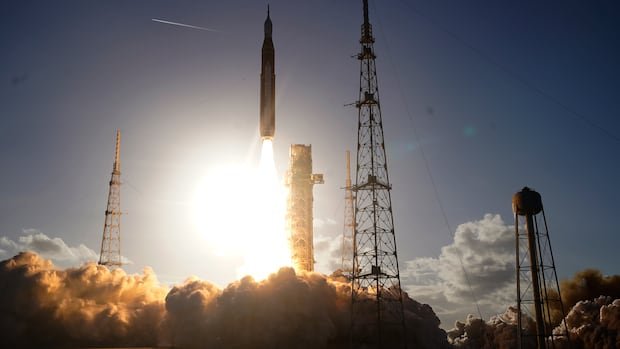

NASA’s Artemis program has garnered attention for its mission to launch astronauts around the moon. However, underlying this objective is a broader strategic competition between the United States and China to reintroduce humans to the lunar surface.
This rivalry extends beyond symbolic gestures like planting flags and footprints. The race now encompasses the potential advantages in selecting prime locations for future lunar infrastructure, establishing technical standards, and shaping the next phase of space exploration.
During NASA’s recent Ignition event, officials stressed the imperative to return Americans to the moon before China and before the conclusion of U.S. President Donald Trump’s tenure. Jared Isaacman, the billionaire chosen by Trump to head NASA, emphasized the urgency by stating, “NASA has committed to sending Americans back to the moon before President Trump’s term ends, while our main competitor has set a target of before 2030.”
The competition is now in full swing, at least in political terms. NASA is fast-tracking plans to land Americans on the moon by early 2028, whereas Wu Weiren, China’s chief lunar program designer, has affirmed that “By 2030, the Chinese people will surely step foot on the moon. That’s a certainty.”
Casey Dreier, the chief of space policy at the Planetary Society, doubts the feasibility of the 2028 target. Nevertheless, he acknowledges that China has served as a valuable motivator for NASA and its supporters by showcasing ambitious lunar spaceflight objectives.
This renewed moon race, unlike the previous Apollo program, is not just a sprint but a prolonged endeavor with the intention to establish a sustained lunar presence. Dean Cheng, a senior fellow at the Potomac Institute for Policy Studies specializing in China’s space program, notes China’s track record of fulfilling its space ambitions, lending weight to its 2030 lunar target.
While some argue that the U.S. has always been the first to reach the moon and both countries are inevitably heading back there, the current Artemis program is a collaborative effort involving not only NASA but also international partners like the Canadian Space Agency, the European Space Agency, and JAXA (Japan Aerospace Exploration Agency).
The strategic importance of the moon’s south pole lies in its potential for establishing lunar bases near permanently shadowed craters that may contain water ice. This resource could be crucial for producing drinkable water, breathable oxygen, and rocket fuel, highlighting the significance of being the first to secure access to such valuable sites.
The urgency to lead in lunar exploration was palpable at the Ignition event, where Isaacman emphasized the need to accelerate lunar missions rather than focusing on excessive bureaucracy. The frequency of lunar missions could have long-term implications in shaping the future rules and technical standards of space travel.
One major challenge facing NASA is securing adequate funding for its lunar endeavors. To bridge the financial gap, NASA is increasingly relying on private industry, leading to a competition between billionaire-led companies like SpaceX and Blue Origin in developing lunar landers for the Artemis program.
This new space race contrasts with past efforts, as it involves collaborative international partnerships and private entities alongside state-driven programs like China’s. While the moon remains a crucial milestone, both the U.S. and China view it as a stepping stone for further exploration of Mars and beyond.