

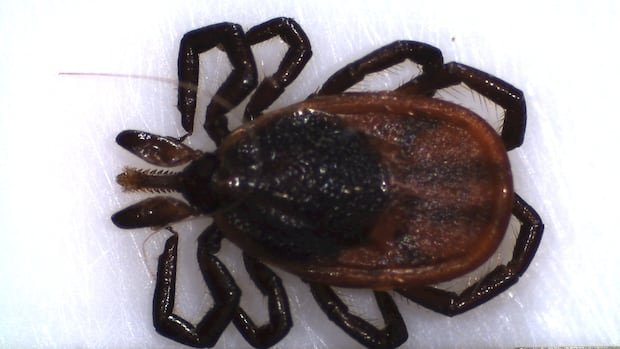

A snowy winter in Nova Scotia may not lead to a decrease in the tick population this year as many would hope. Tick experts explain that deep snow cover can actually provide insulation for ticks, aiding their survival through the winter.
Laura Ferguson, an assistant professor at Acadia University, mentioned that the snow cover acts as a protective layer for ticks, allowing a significant portion of them to survive and reemerge soon. While there were cold spells in December and January, the sustained tick-killing temperatures occurred after the snow had already insulated them.
Ticks typically seek sheltered areas under leaf litter during winter, where they can survive without feeding for extended periods. Ferguson highlighted that ticks can endure temperatures between 0°C and -5°C for weeks or months. Sudden temperature fluctuations or consistent temperatures below -10°C can result in mortality, as ice formation inside their bodies can be fatal.
Jantina Toxopeus, an associate professor at St. Francis Xavier University, noted that ticks can freeze at temperatures below -15°C in laboratory conditions. However, the speed of temperature change plays a role, with ticks adapting better to gradual temperature drops.
Despite extreme cold spells in the past, Toxopeus observed that ticks in Nova Scotia have shown resilience to survive harsh winter conditions. She emphasized that extreme low temperatures do not necessarily eliminate ticks, as they have mechanisms to cope with cold weather.
Ferguson predicts that this year’s tick season is likely to be similar to previous years due to the robust tick population in the region. The experts suggest that the snowy winter in Nova Scotia may not hinder the tick population as anticipated, emphasizing the ticks’ adaptability to cold weather conditions.